Destinations · Escale Privée
Tbilisi, Georgia
Warmth as architecture.
The city does not announce itself. You arrive — from the airport, through suburbs that could belong to any provincial capital with ambitions it has not yet resolved — and then something shifts. A hill appears. Then a cliff. Then, on the cliff, a church that has been watching the river below for a thousand years with the patient attention of something that has no reason to look away.
Tbilisi earns itself slowly. This is one of its principal qualities.
I. The grammar of the balcony
The first thing you understand about old Tbilisi is that its architecture is not decorative. It is philosophical.
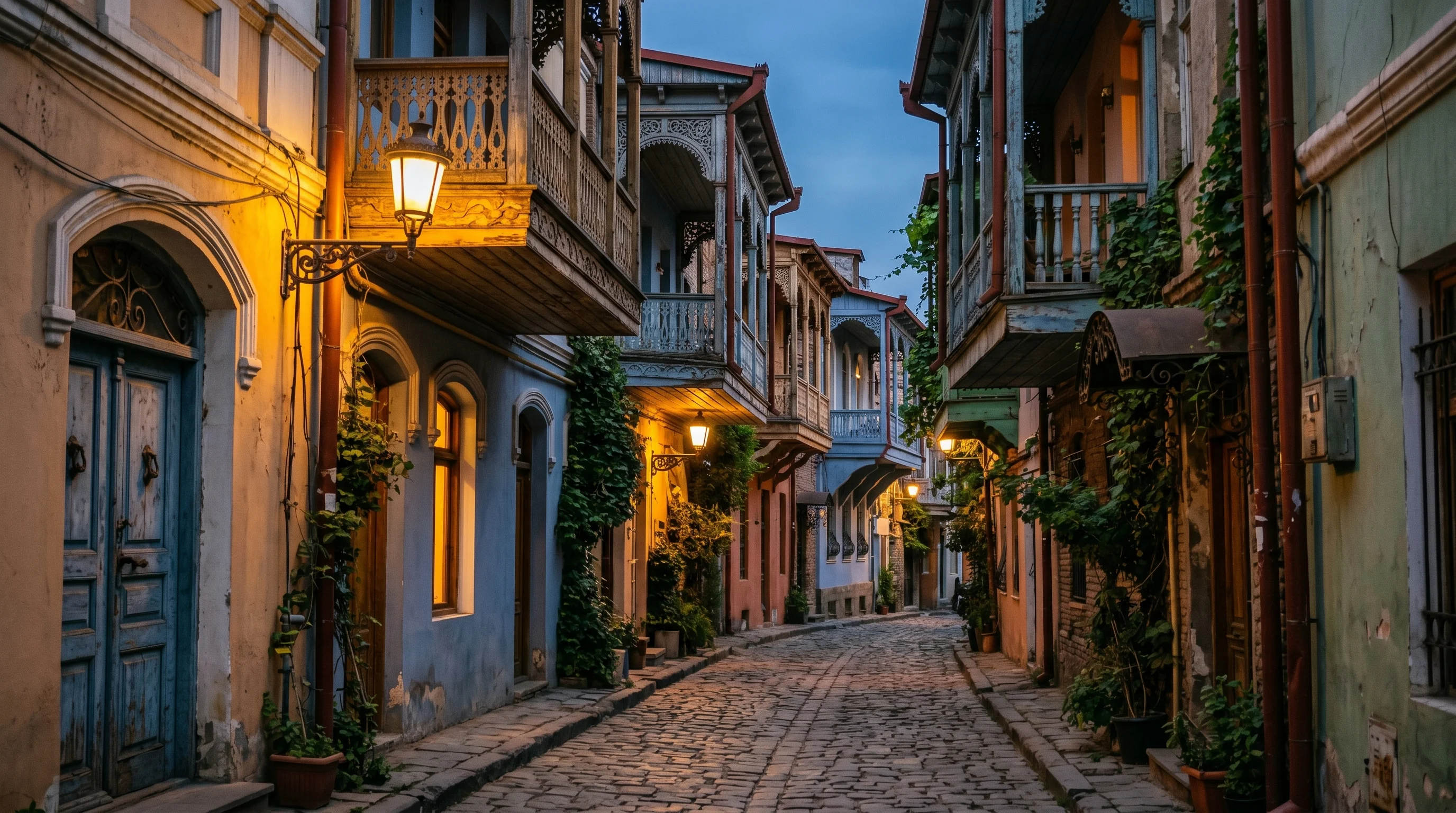
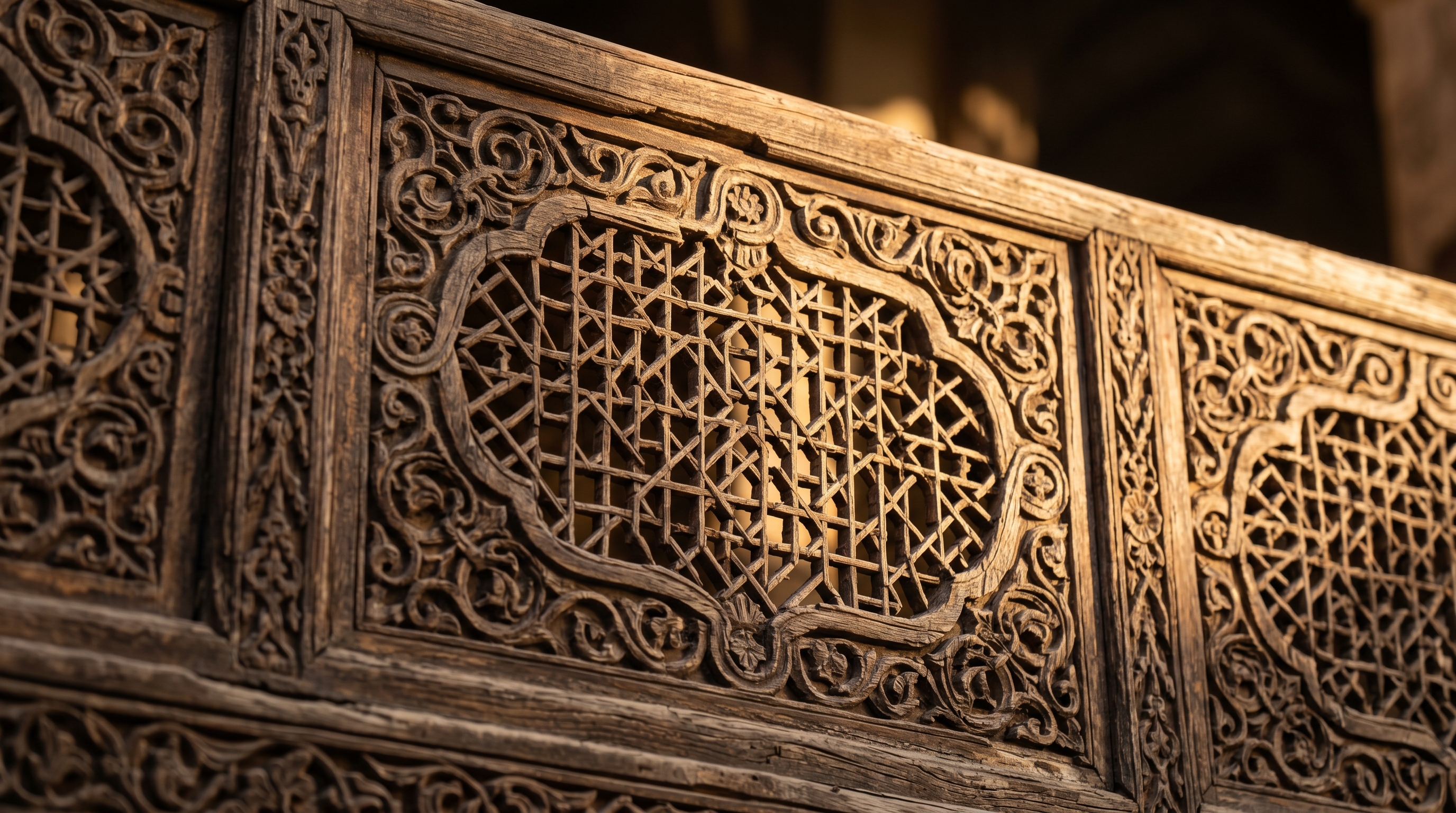
The balconies — those extraordinary carved wooden structures that project from the facades of the old town houses like the prows of ships that have decided not to sail anywhere — are not ornamental additions. They are the primary room. The place where the family lives in summer, where the evening passes, where a neighbour calls up from the street and receives an answer without anyone needing to go inside. They hang over the lanes of Abanotubani and Kala in various states of resolution: some freshly painted, some collapsing gently into the vines that have grown up to meet them, some held together by what appears to be confidence alone.
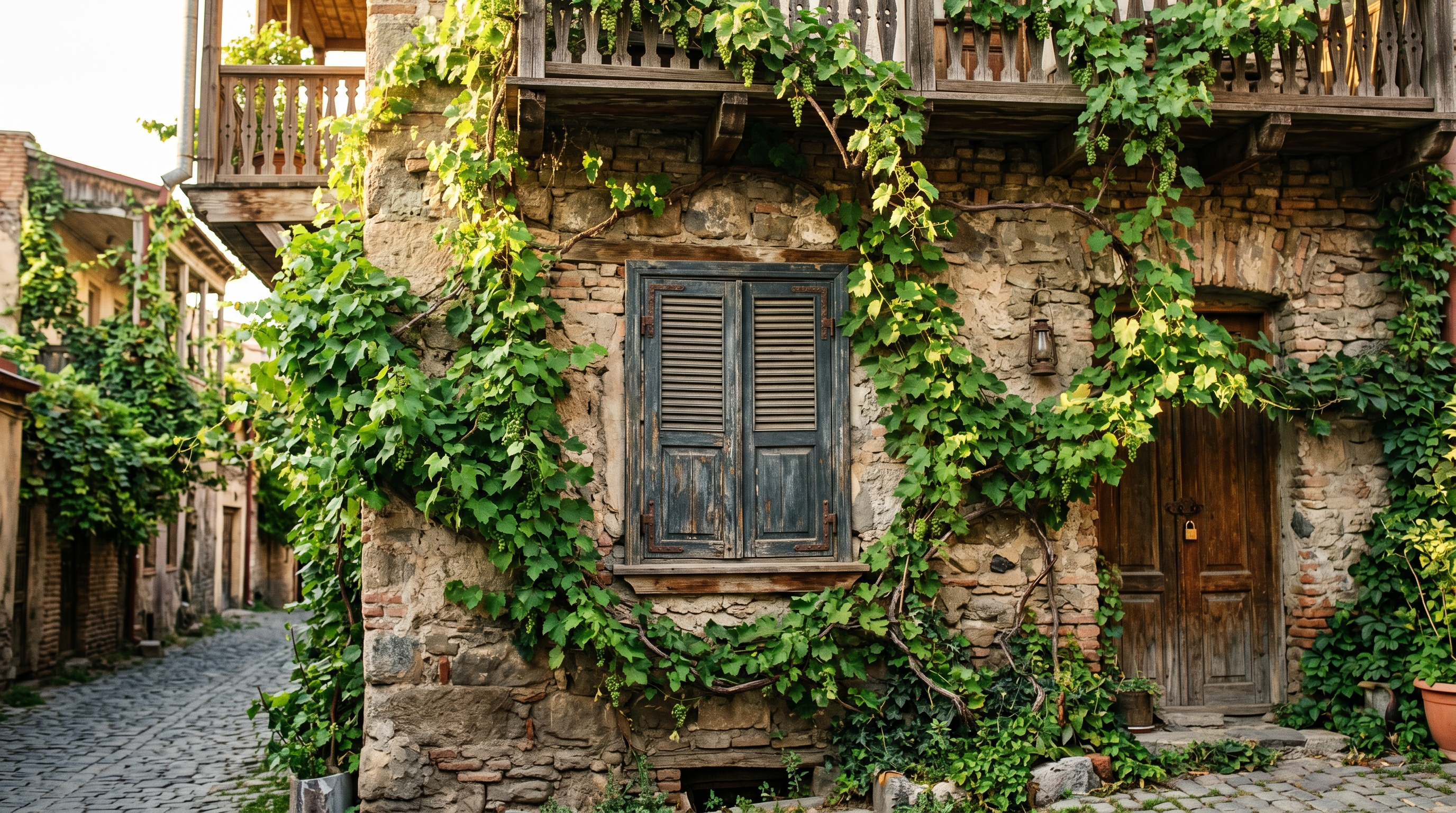
The vine on the facade is not a design choice. It is a declaration. Georgians have been cultivating wine for eight thousand years — a number so large it resists comprehension, a span that makes the entire history of Champagne feel like a recent experiment. The vines grow on the houses the way language grows in a family: naturally, specifically, with a character that belongs to this place and not to anywhere else.
To walk through the old town at dusk, when the stone is still warm from the day and the light comes at an angle that turns the wooden balconies the colour of old honey, is to understand something about the relationship between a city and its inhabitants that cannot be learned from a description. You can feel, in the particular density of the streets, the particular narrowness of the lanes, that these were built for people who intended to stay.
II. The bath
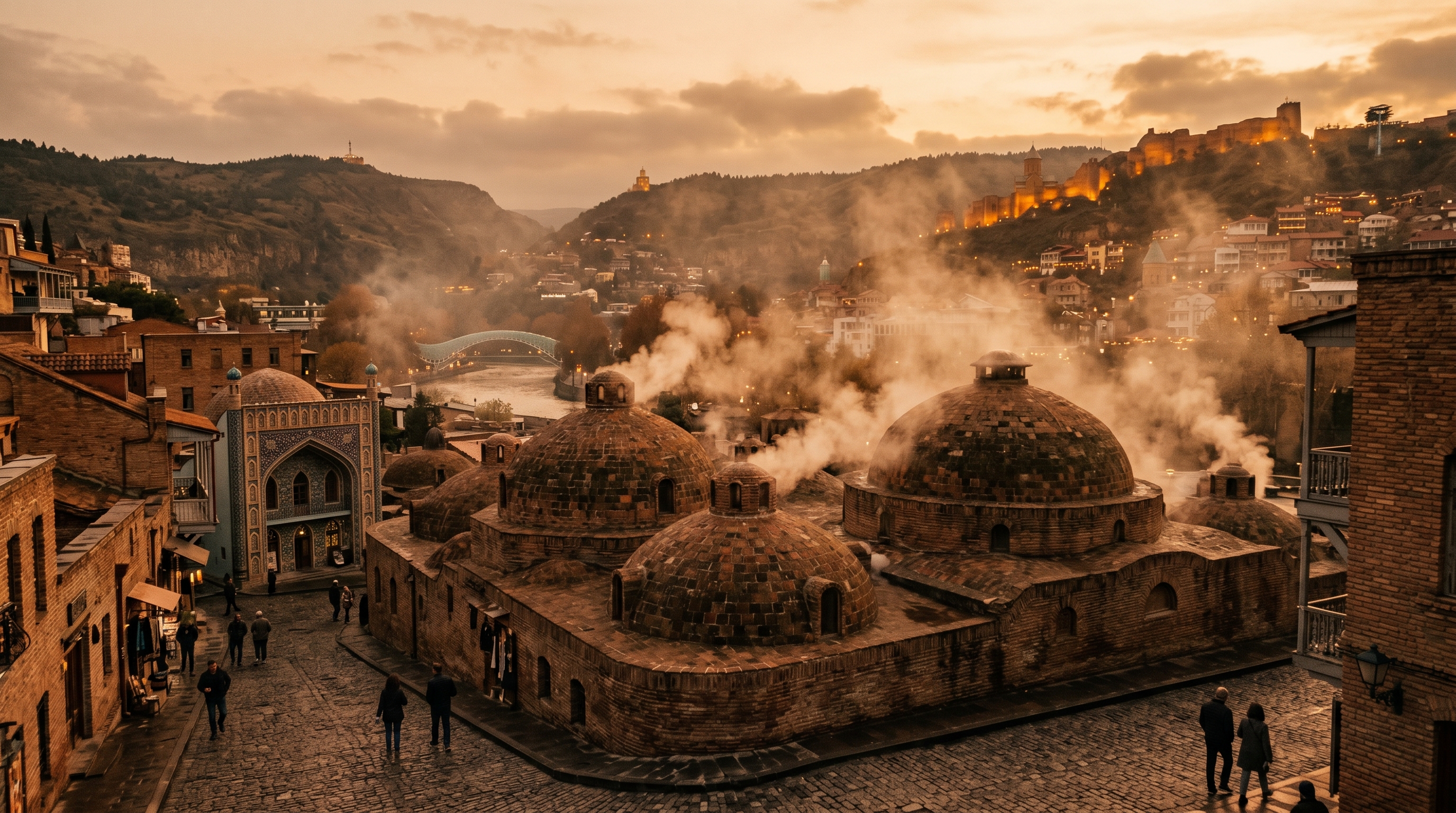
In the Abanotubani district — the name means, simply, bath district — the domed rooftops rise from the ground like the heads of creatures that have not quite surfaced. Below them, fed by the same sulphurous springs that, according to the founding legend, caused a Georgian king to build his capital here in the fifth century, are the baths.
The legend holds that the king was hunting on this hillside when his falcon caught a pheasant, and both birds fell into a hot spring and emerged, or so the story goes, cured of whatever had been ailing them. The king looked at the steam rising from the ground and decided: here. This is where the city will be.
Founded on the principle of healing, of warmth that rises from the earth without effort — this is not nothing, as an origin story. It explains something about the city's character that other explanations cannot quite reach.
The baths themselves are entered with a certain amount of ceremony, or they were when ceremony still meant something. You descend below street level. The air changes. There is the particular smell of sulphur — not unpleasant, the way you might expect, but mineral, old, geological: the smell of something that has been happening without interruption for a very long time. The water is hot. You stay longer than you intended. You leave softer.
The city, in this respect, functions as a spa. Not in the contemporary sense — the curated wellness retreat, the programme, the carefully scheduled treatments. In the older sense: a place where the ground itself offers restoration, and where to sit in warm water in a vaulted room is not an indulgence but a habit, repeated for generations, stitched into the ordinary week.
III. The table
In Georgia, hospitality is not a service industry. It is a moral position.
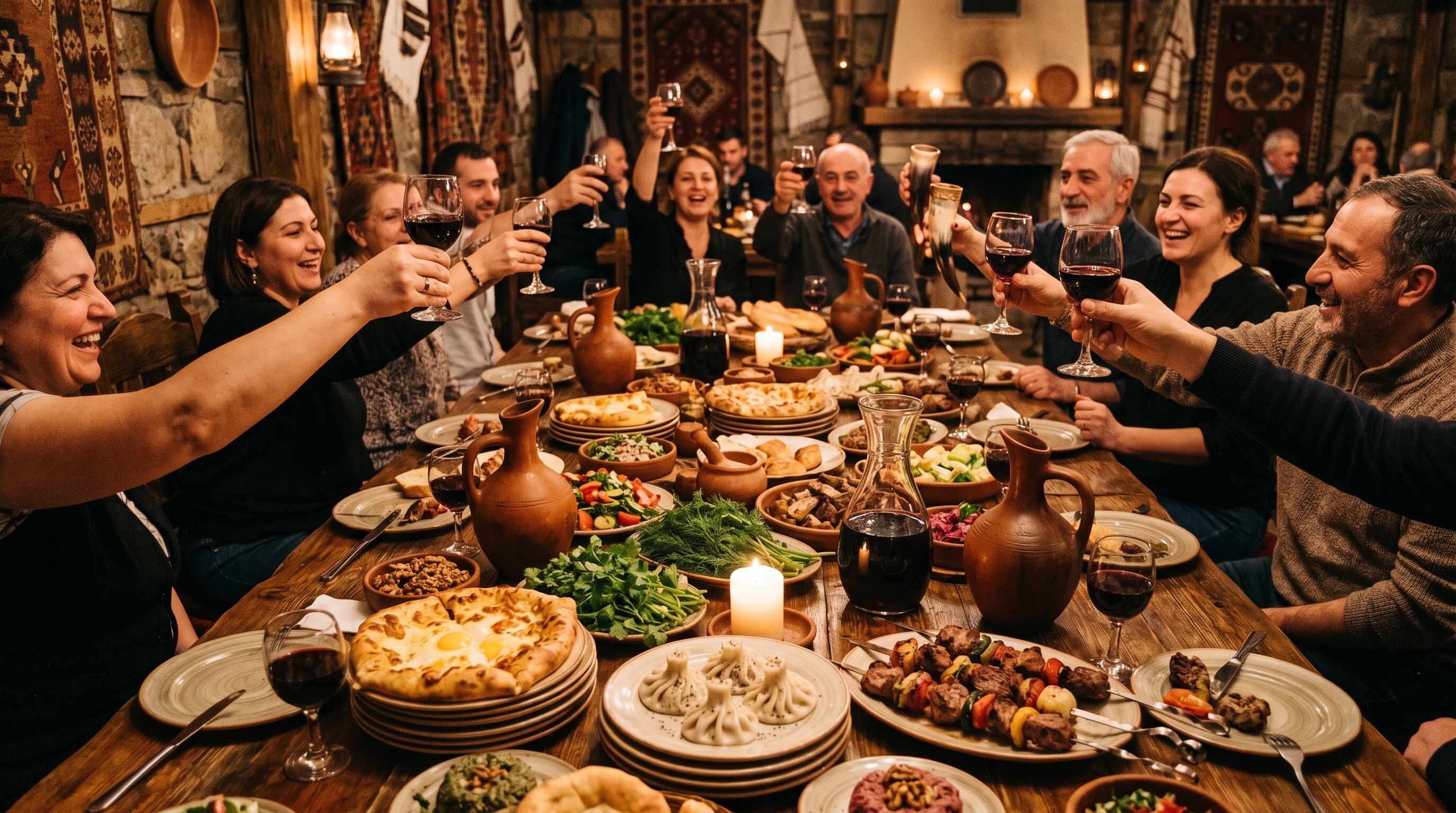
The supra — the Georgian feast, the long table, the toasts that unfold with the patience and ceremony of a liturgy — is not a special occasion. It is the default condition. Guests arrive and the table grows. The wine appears before you have asked for it, in a clay jug that has been in the family longer than anyone can remember. The bread comes from a tone oven, the long cylindrical baker's oven sunk into the floor, where the dough is slapped against the hot walls and emerges minutes later with the specific char that no other method produces.
The toast is made by the tamada — the toastmaster — and it is not quick. A Georgian toast is an address, a meditation, a small speech that reaches toward the serious things: life, love, the dead, the living, the country, the guest who has arrived from far away and must be made to understand that arrival here is not incidental. That they were expected, in some essential sense, long before they knew they were coming.
This is hospitality as architecture: the culture has been constructed around the premise that the stranger at the door is a gift, and that to receive them poorly is a failure not of etiquette but of character.
For the traveller who has become accustomed to the managed welcome — the laminated card on the pillow, the turndown chocolate, the carefully worded note from the general manager — the Georgian table is a recalibration. It reminds you what the word welcome was intended to mean before the hospitality industry made it a protocol.
IV. The city at its own pace
Tbilisi does not operate on a schedule that a visitor sets. It operates on its own.
The old town wakes slowly. By ten in the morning, the lanes are still quiet enough that you can hear the specific sound of a wooden shutter being opened three floors up, and the particular silence that follows it. By noon, the cafes are full — not with tourists following a map, but with people who come here every day, to the same corner, to the same glass of something cold, to the same view of the street that they have been watching for years.
The city has been ruined and rebuilt so many times — by Arab invasions, Mongol armies, Persian campaigns, Russian annexation, Soviet standardisation, and the quieter destructions of the post-independence years — that it has developed a specific relationship with impermanence. The crumbling facades are not neglect. They are evidence. The city has survived everything and carries the marks.
This is, in the language of quiet luxury, the rarest quality: patina. Not the artificial ageing applied to new hotel lobbies to simulate depth. The actual accumulation of time, readable in the stone, in the wood, in the way the streets have been worn by feet that preceded yours by centuries.
You come to Tbilisi expecting a destination. You leave understanding that it is a condition.
— The Editor