Field Notes — Final · Escale Privée · Amalfi Coast, April 2026
Field Notes, N° —
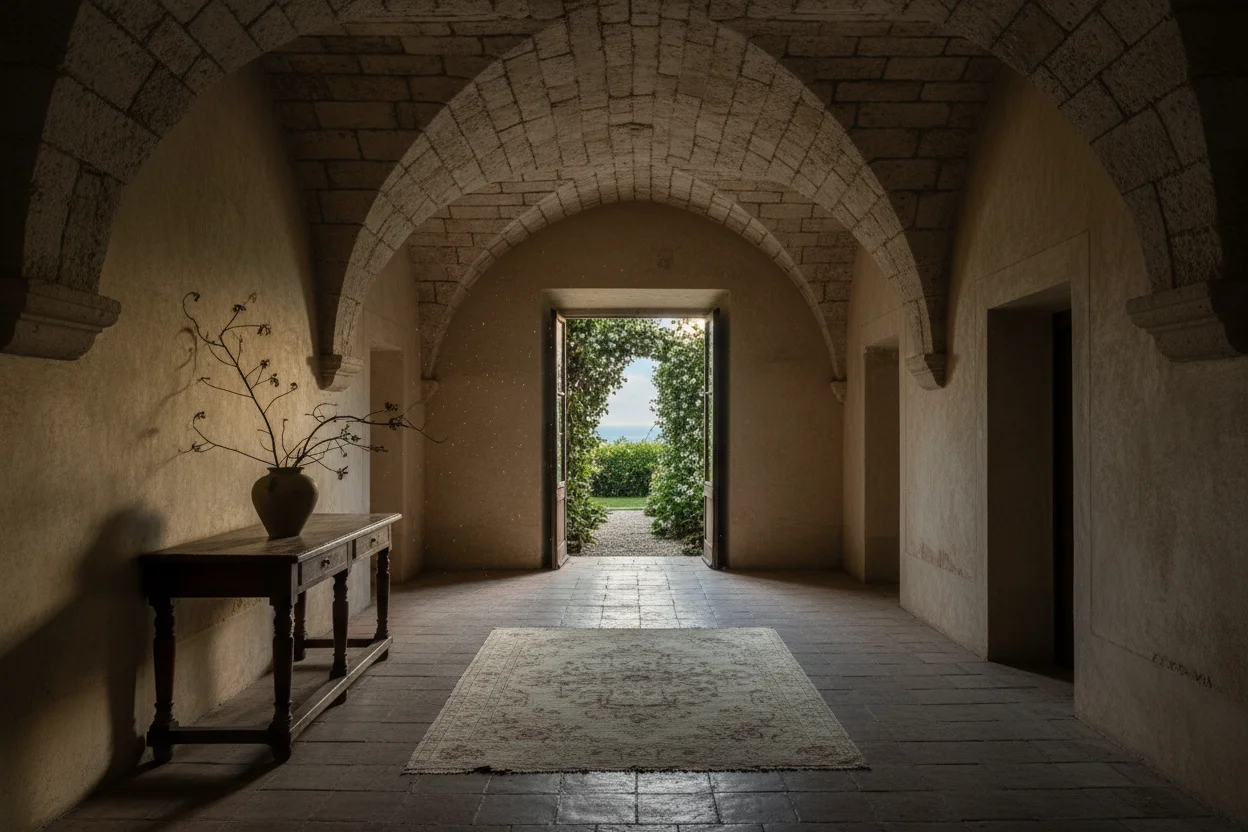
Field Notes · Escale Privée Amalfi Coast, April 2026 The Concierge Who Remembered I’m not sure his name was truly Lorenzo. I may have remembered it wrong. In Ravello, memory works differently than in cities you arrive in with a specific purpose. Here, everything slips down by one tone: names, hours, the order of days. What remains is a gesture, the slight incline of a head, the way someone approaches not too fast and not too slow—exactly when you were about to ask for something, but had not yet found the words. I arrived at Villa Cimbrone in the late afternoon. The road up from Amalfi always takes longer than it seems, and longer than the body wants after a flight. Switchbacks, stone walls, lemon gardens that at this time of year still scent the air cautiously, as if unsure whether the season has truly begun. The driver barely spoke. He knew the last minutes before Ravello are best left undisturbed. The hotel stands at Via Santa Chiara 26. It doesn’t look like a hotel. It looks like a residence that has agreed to the presence of guests, but has no intention of changing its pace because of them. You enter without fanfare. A door, stone, coolness, a smell you can’t quite name—somewhere between old wood, damp April, and wax that has been worked into these surfaces for decades.
And that’s when I saw him. He stood deeper in the lobby, not at the desk, as if deciding the desk was an unnecessary stage. He didn’t come over immediately. He gave me a moment to orient myself in the space. That was the first thing that struck me: I wasn’t “served.” I was let in. He said my surname. Mine. Without looking at a screen. Without the small pause you can usually hear in people reading from a system. He simply spoke it, the way you speak something you already know. It should have been a minor detail. In most hotels, it would be. But at Villa Cimbrone—after an hour of switchbacks, after the flight, after all that April light that had already started lowering my pulse at the threshold—that detail sounded different. As if someone had said: I know you’ve arrived. Not at a hotel. Here. He didn’t lead me straight to the room. First, a few steps toward the garden—literally only a handful—so I could see where I was before I began unpacking. He said something brief about the gardens that I no longer remember precisely. I remember the tone. He spoke of them the way you speak of someone familiar, someone you don’t want to introduce too quickly. The wisteria had only just begun to bloom. Part of the pergola was already dusted with violet; part still held its buds closed.
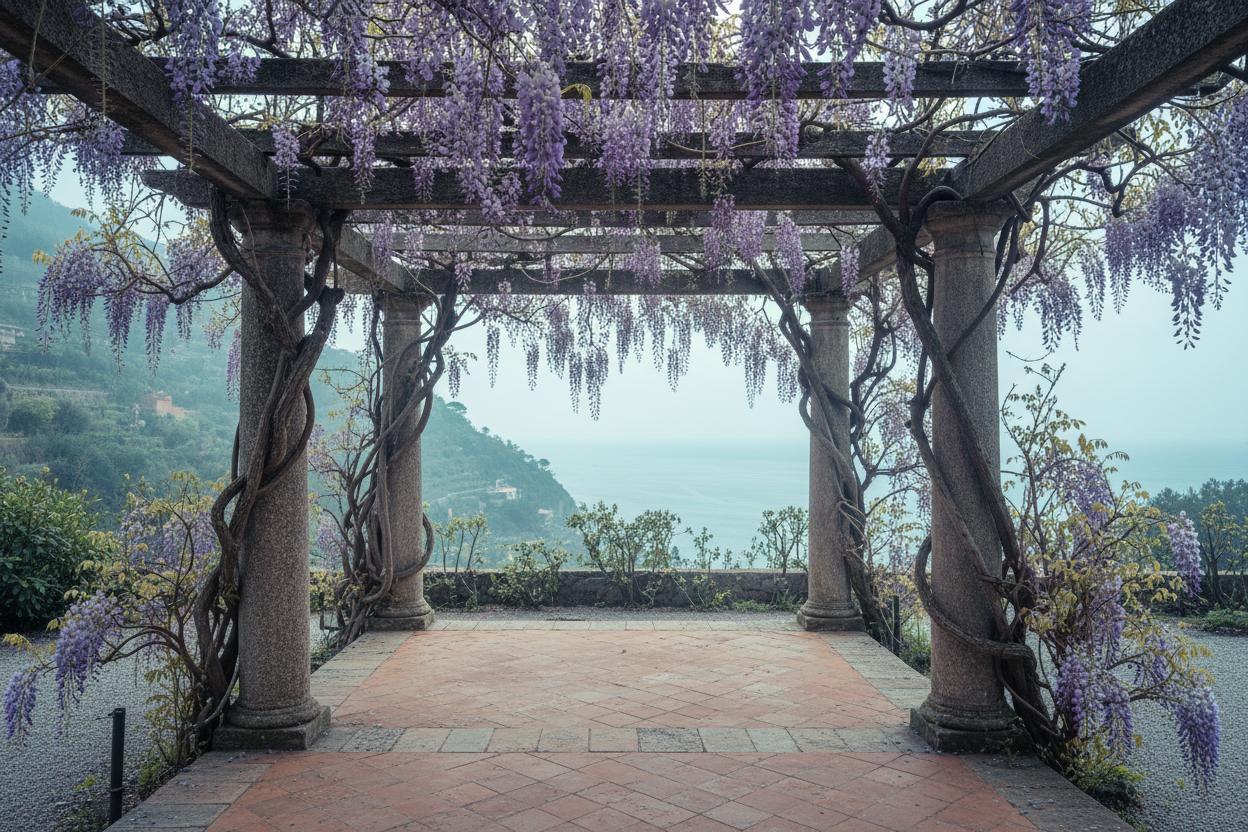
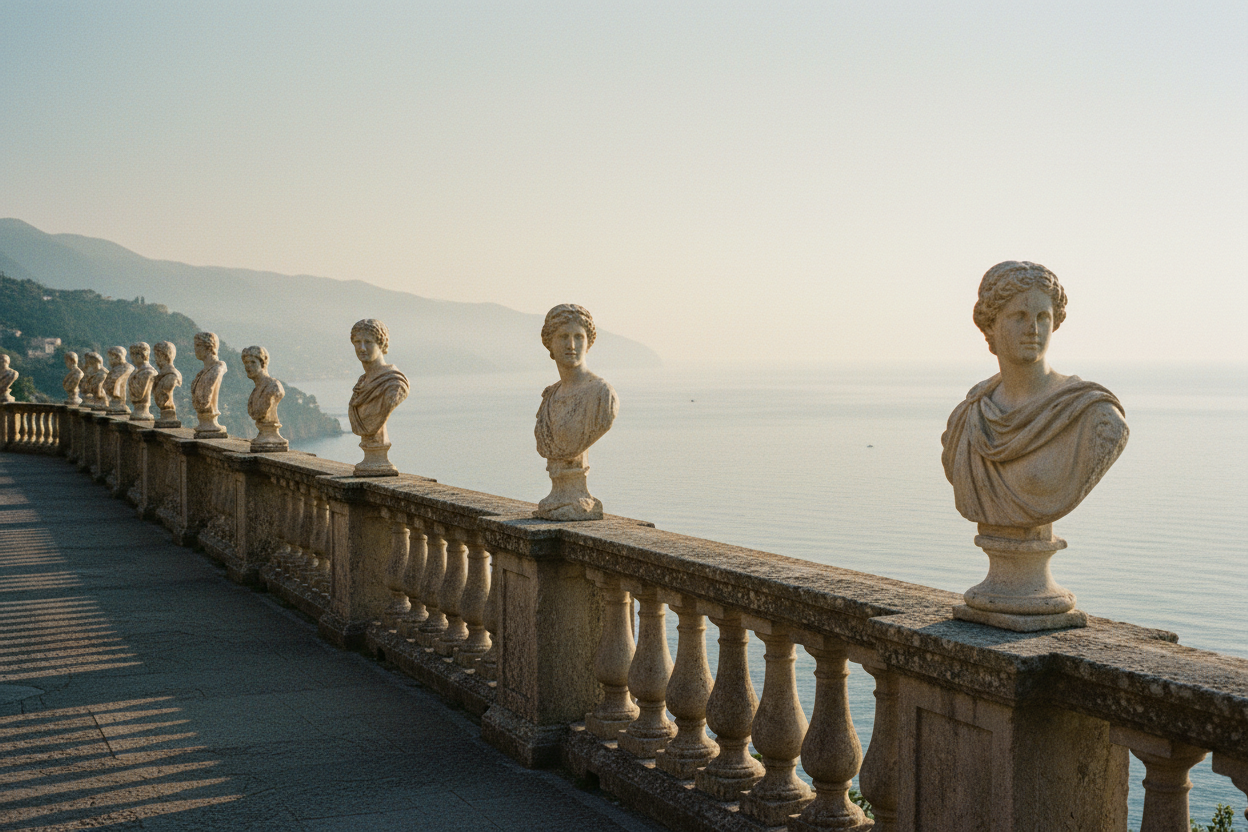
For clarity—because not every reader needs to know this, and a photograph never tells the whole story. Wisteria (Wisteria) is a climbing plant in the legume family, originally from East Asia and North America, which made itself at home in the gardens of the Mediterranean in the nineteenth century, including along the Amalfi Coast. It grows along pergolas, stone walls, and villa façades, wrapping them in thick, woody stems that, over time, become part of the structure. It blooms once a year—usually from late March to mid-May—sending out long, hanging clusters of small, pea-like flowers in shades from pale lavender through deep violet to white. The scent is intense—somewhere between lilac, honey, and fresh sweet pea—but its life is short: peak bloom lasts two or three weeks, and then the pergolas are left with green alone. In Ravello, and especially in the gardens of Villa Cimbrone, wisteria forms violet tunnels that are photographed in April more often than any other element of the property. In April, Amalfi is not yet entirely sure of itself. There is no summer excess. No loud tour buses, no crowd on the Terrazza dell’Infinito, none of that tired energy the coast can carry in August. There is a quiet that, at times, sounds almost improper. I remember thinking something very simple then: it had been a long time since I’d been somewhere that wanted nothing from me. The concierge—let him remain Lorenzo, since that’s how I wrote him down—didn’t try to become part of the scene. He didn’t explain the view. He didn’t ask questions that sound polite but in truth merely keep the conversation moving. He stood half a step behind and waited until I decided I was ready to go on. I spent years in hotels. Ten in Front Office. I know exactly how much training it takes to stand like that: not to fill the silence, not to “sell” a view that sells itself, not to try to be remembered, but to allow the place to be what stays in memory. Most people in this profession can’t do it. Not because they’re bad at what they do—because no one taught them that refinement begins where the need to be seen ends. I remember the room less clearly than the path to it. I know the window faced the garden. I know it was tall. I know the pillows were right, and that at this time of year the light came in at a slant, drawing the space more than illuminating it. The rest of the details dissolved the way most rooms in good hotels dissolve. Because in good hotels, the room isn’t a stage. It’s a background. I went down to the garden several times: in the morning, when only the gardeners were there; in the late afternoon, when the light settles on the stone busts of the Terrazza dell’Infinito until they begin to look like people who have decided to remain silent; in the evening, when the day visitors had already disappeared and the garden returned to the hotel—to the guests, to its older self.
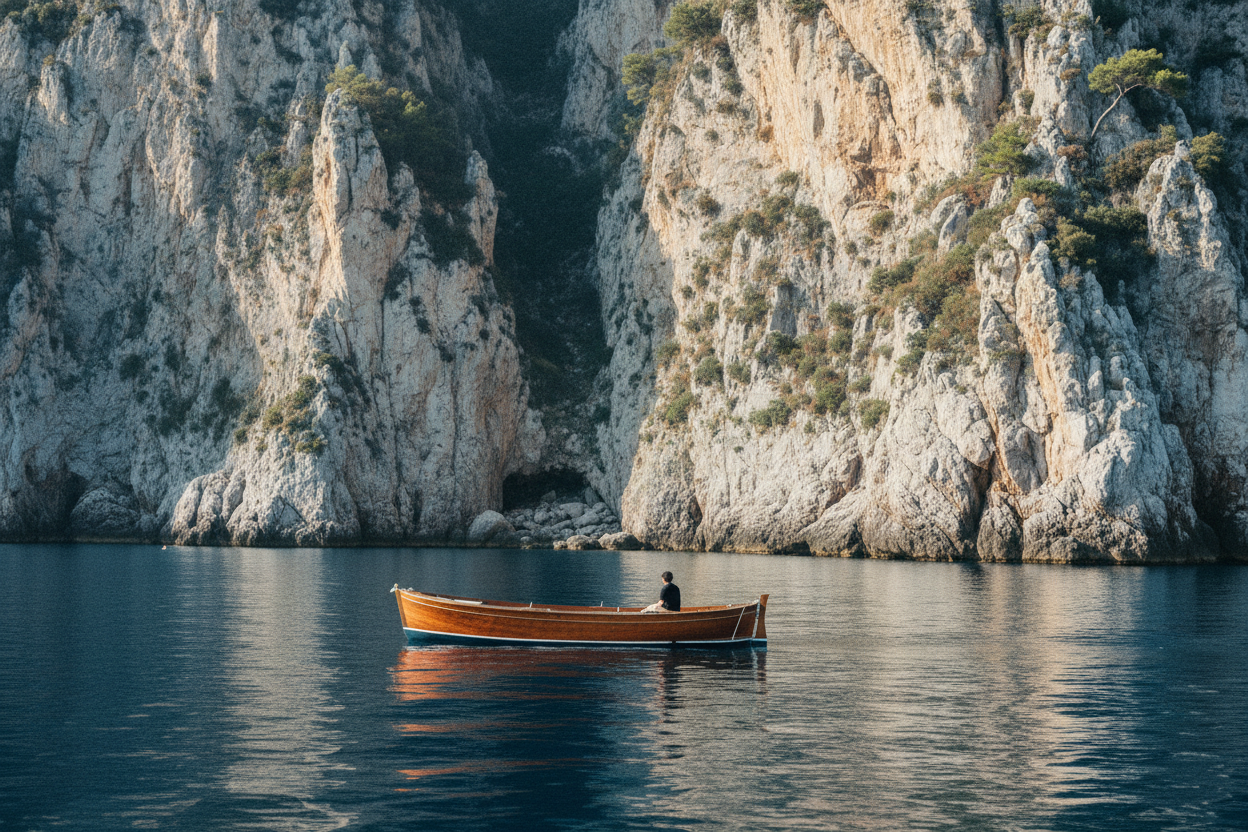
On the first day, Lorenzo mentioned the hours in passing. Not as a recommendation—more as information. He said the Villa Cimbrone gardens are also open to visitors from outside, so midday can be busy; and that if I cared about quiet, it was best to go early in the morning or after five, when tickets stop being sold and only hotel guests remain. He didn’t propose a plan. He didn’t book me a slot. He simply told me when it was worth being there—and left me with that knowledge. On the second day, as I was leaving the lobby, he stopped me for a second and said the sea would be calmer that afternoon than the next. Nothing more. I didn’t even ask how he knew. He did—and that was enough. Later I thought it wasn’t a forecast. It was the experience of someone who lives in a place where weather is part of the job. We boarded a small private boat along the coast—unshowy, without ceremony, no gloved waiter, no champagne bottle that needed to be photographed. The skipper had calm hands. He spoke little. He knew where to slow down and where to go deeper into the shadow of the cliffs. I remember that at one point he cut the engine, and for several seconds there was nothing. No waves, no voice, no other boat in sight. Only rock, water, and air that in April smells different than in July—cooler, cleaner, without that summer sweetness that eventually becomes tiring.
I returned to the hotel with a feeling I can’t quite name. It wasn’t rapture—rapture is loud. It was closer to relief. As if someone had lifted from my shoulders the duty of being someone. That evening I ate dinner without haste. I didn’t order anything ambitious. The hotel didn’t try to coax me into anything. No one came to propose a tasting menu, an extra course, an “experience.” It was one of those rare dinners in which you don’t feel the work of the kitchen; you feel only that someone, somewhere, simply knows what they’re doing. On the third morning, I asked for breakfast later, delivered to the room. The next day—without any conversation in between—it arrived at exactly the same time, on the terrace, in the same arrangement. No one asked whether it should be the same again. It simply was. It sounds like nothing. In truth, it is everything. Because in hospitality there are two entirely different kinds of memory. One is the system’s memory: reservation number, status, room category, date of the last stay, pillow preference if someone once typed it in. That kind of memory can be bought. Implemented. Measured in KPIs. The other is human memory. It knows the guest prefers a later breakfast not because it’s in a profile, but because on the first day they asked—and they don’t want to have to say it again. It knows that when someone comes back from the gardens, you don’t stop them with “Do you need anything?” It knows there are guests who want conversation in the evening, and guests who ask for a whisky only so they can hold a glass and not have to speak to anyone. You can’t roll out that second kind of memory in a single quarter. It is built over years. It requires a team that stays. It requires a culture in which a younger colleague watches an older one read a guest, and slowly learns the same. It requires someone like Lorenzo—whoever he truly was. And it requires one more thing the industry rarely speaks about. It requires restraint. Today’s hospitality is very fond of the word personalisation. It uses it lightly, sometimes too lightly. In many places, personalisation means my name appearing on the television screen, a welcome card with the manager’s handwritten signature on the desk, and a chocolate bar with the hotel logo in the bathroom. These are gestures. Some pleasant. Most unnecessary. The real personalisation at Villa Cimbrone was not of that kind. It was not decorative. It was operational and at the same time invisible. It was not about someone adding something to me. It was about someone removing something from me. It removed the necessity of explaining myself a second time. The necessity of negotiating hours. The necessity of clarifying that I did not want “the full programme.” The necessity of repeating that I prefer shade to sun, that I do not need a recommendation for every restaurant in the area, that I do not want to be led. On the first evening I had not yet noticed the mechanism. By the second I had. By the third I had begun to trust it. This is the moment in which a hotel ceases to be a provider of services and becomes a place. I thought then of something that has stayed with me for a long time. That luxury in travel is not about being given more. It is about not having to explain oneself. Lorenzo, if that really was his name, never made me explain. Not once did he ask why I had chosen a particular hour. Why I preferred the garden to the pool. Why I did not want dinner in the restaurant with the view but in the smaller side room. He simply received it, and put it away somewhere from which it later returned as a ready-made fragment of the next day. On the last evening, after dinner, I went out to the garden once more. I knew I should not have, that it was late, that not everything was available at that hour. But I also knew no one would tell me to come back. And no one did. The garden received me the way it receives someone who already knows how to behave in it. The Terrazza dell’Infinito at night looks entirely different than by day. There is no longer a sea in the sense of a view. There is only a black plane below and a sky which, above Ravello, is denser than one remembers from cities. The busts stand along the balustrade like people who stayed when the rest of the world had gone. From below, somewhere from the coastline, I could hear a single boat. Very far away. Then nothing. I stood there perhaps twenty minutes. Perhaps less. Time in such places stops being reliable. The next morning I was leaving. There was no ceremony of farewell. There were none of those overly long thank-yous one learns in hotel training. The luggage was carried down without comment. The bill had been prepared in advance. Lorenzo appeared at exactly the moment I came down to the hall, not a second earlier. He said a few sentences which, after years in the industry, I recognise immediately — sentences of someone who is not trying to sell anything and not trying to force anything. He simply walked me to the door. And he said the name. Once more. Correctly. This time I already knew it was not about the name. It was about something that loyalty programmes will never fully contain, however long they try. It was about the moment in which a guest feels they have been noticed not as a reservation, but as a person with a particular tempo, a particular sensibility, a particular history, which does not necessarily need to be told. Loyalty programmes have their purpose. Points, statuses, upgrades, late check-outs, breakfast access, lounge access, special rates. All of it works, as long as it is treated as a tool and not as a promise of emotion. They are not emotion. They are mechanics. Loyalty does not begin in mechanics. It begins much lower. In the remembered detail that someone managed to turn into a gesture before the guest had to ask for it. At Villa Cimbrone, someone still does this. I do not know for how long. The industry is changing faster than I would like to admit. Concierges leave. Teams rotate. New people learn more quickly but often more shallowly. Systems grow and begin to replace what was once the intuition of an older colleague. But for a few days in April 2026, I had the rare sense of being in a hotel that does not pretend. That does not try to be the biggest, the newest, the loudest on social media. That simply remembers why people come there. They come to be, for a while, not entirely themselves. And to have someone leave them undisturbed in it. On the way back to Naples, the car was again almost silent. This time not out of the driver’s politeness. Simply because there was no need. In my head I still carried the garden, the stone busts, one spoken name, and a very simple sentence that had been forming on its own for several days. We do not remember hotels by what they gave us. We remember them by what they spared us. Villa Cimbrone spared me, for a few days, from myself. That was more than luxury. That was recognition.
Editor’s note
Hotel Villa Cimbrone in Ravello, Via Santa Chiara 26, officially lists among its services concierge, a private helipad, boat tours, wellness, breakfast and room service, swimming pool and solarium. The hotel describes the mission of its concierge as the creation of bespoke experiences. The name “Lorenzo” is an editorial figure; the stay described refers to a real place and real services, but staff members and exact fragments of conversation have been recorded from the author’s perspective rather than as a transcript. Escale Privée does not treat Villa Cimbrone as a family resort, but as a hotel in which personalisation remains part of the culture of the place. The photographs illustrating the text have been prepared editorially and do not depict specific rooms or persons from the hotel.
Sources: Hotel Villa Cimbrone — Services, KAYAK — Hotel Villa Cimbrone, Tripadvisor — Villa Cimbrone Hotel.