What hotel membership programmes reveal about the distance between a point and a promise.
I. The Promise at the Counter
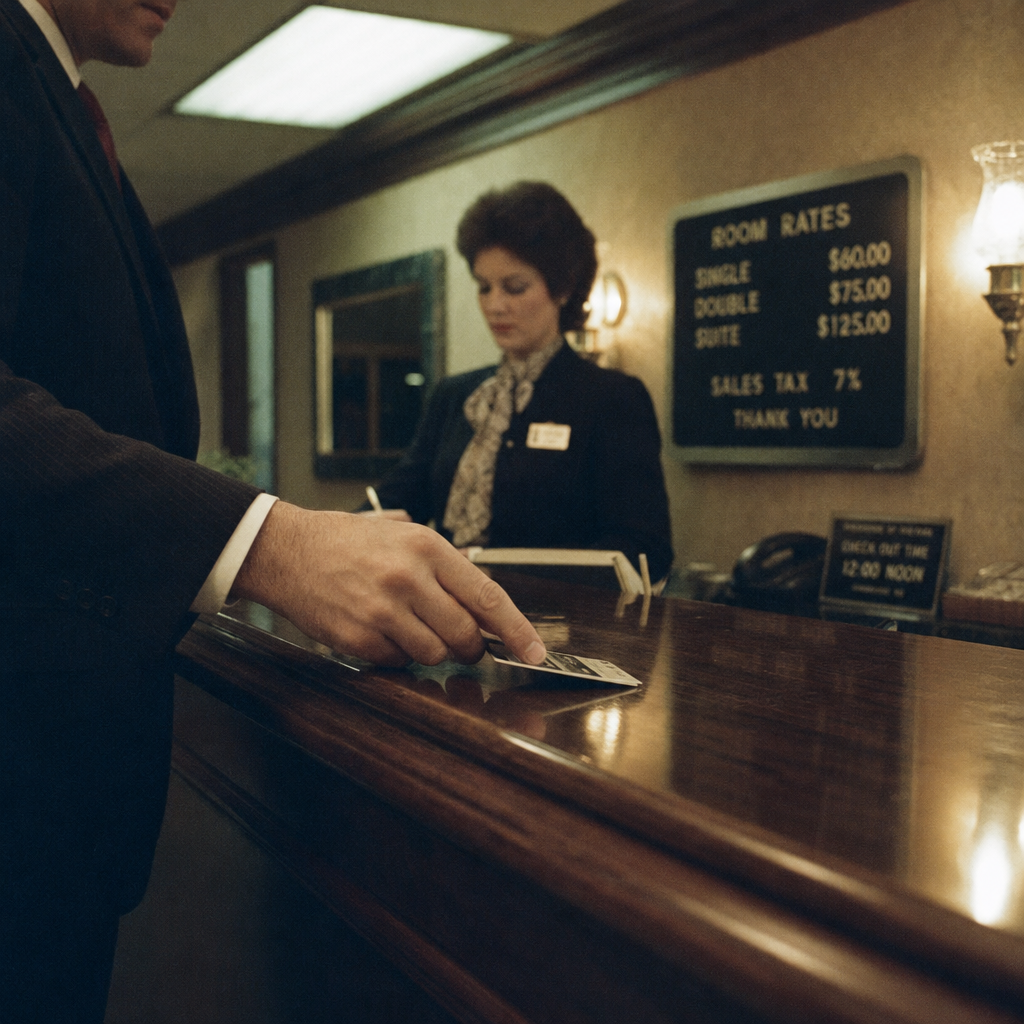
Hotel loyalty programmes were not invented for the guest who travels slowly. They were designed in the 1980s for the business traveller moving on a company card — a person for whom the hotel was infrastructure, not experience. Frequent stays, reliably accumulated. The logic was transactional: return often enough, and the hotel would subsidise future returns. A system of deferred discounts dressed in the language of gratitude.
For decades, that logic held. Marriott's programme, launched in 1983, pioneered the model. Hilton followed. The airlines had already shown the way. The points economy was born — and with it, a curious inversion. Guests began choosing hotels not for the quality of their sleep, but for the velocity of their accumulation.
What this created was not loyalty. It was arithmetic.
The question worth asking — the one that the industry is only now beginning to take seriously — is whether arithmetic and belonging can coexist. Whether a number on a screen can carry the weight of recognition. Whether a programme can be engineered to make a guest feel, genuinely, that the house remembers them.
Most of the time, it cannot. But the attempt is revealing.
II. Scale and Its Discontents
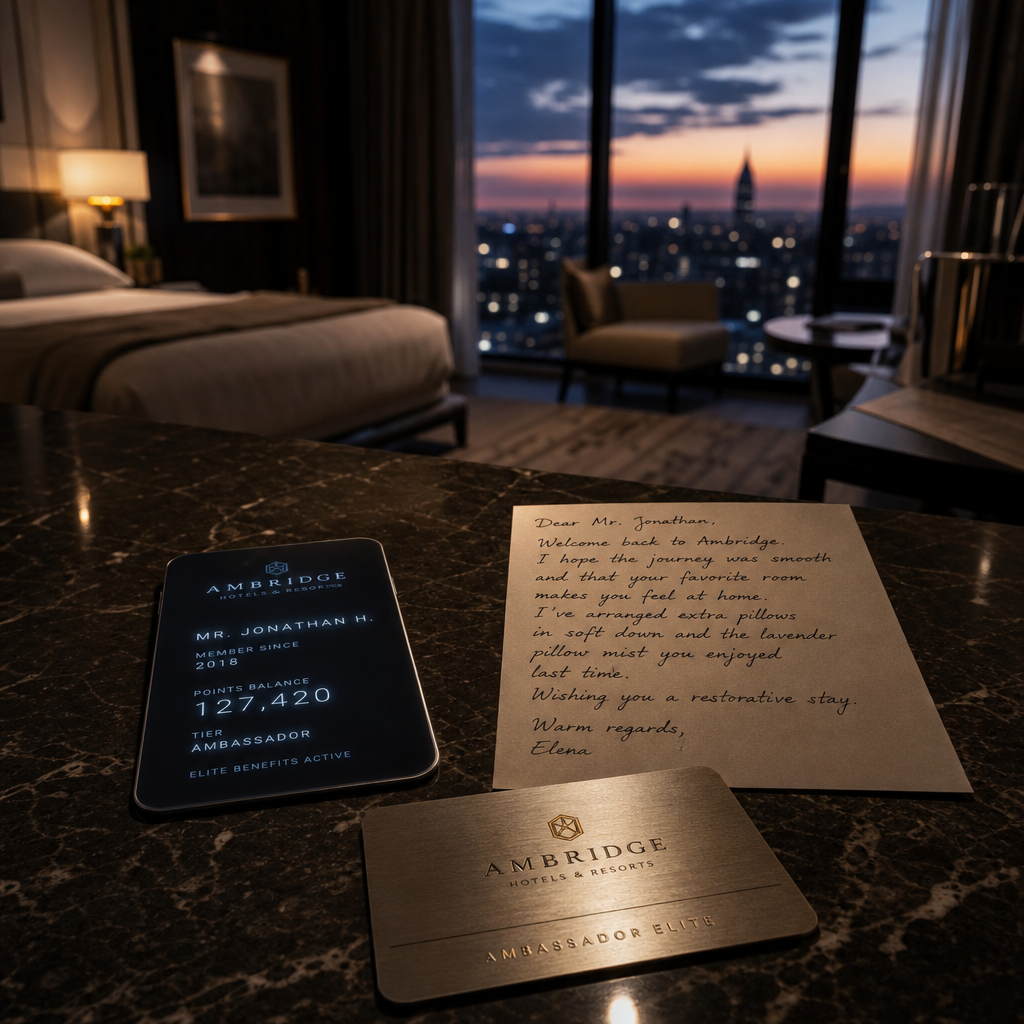
Marriott Bonvoy is, by most measures, the largest hotel loyalty programme in the world. It encompasses over 30 hotel brands — from the functional midscale of Courtyard to the considered restraint of Ritz-Carlton, from Moxy's cheerful informality to the long corridors and hushed libraries of St. Regis. It counts its members in the hundreds of millions. Its points are earned on credit cards, transferred from airlines, accumulated at properties on six continents.
The scale is genuinely extraordinary. And scale, in any human institution, carries a specific cost.
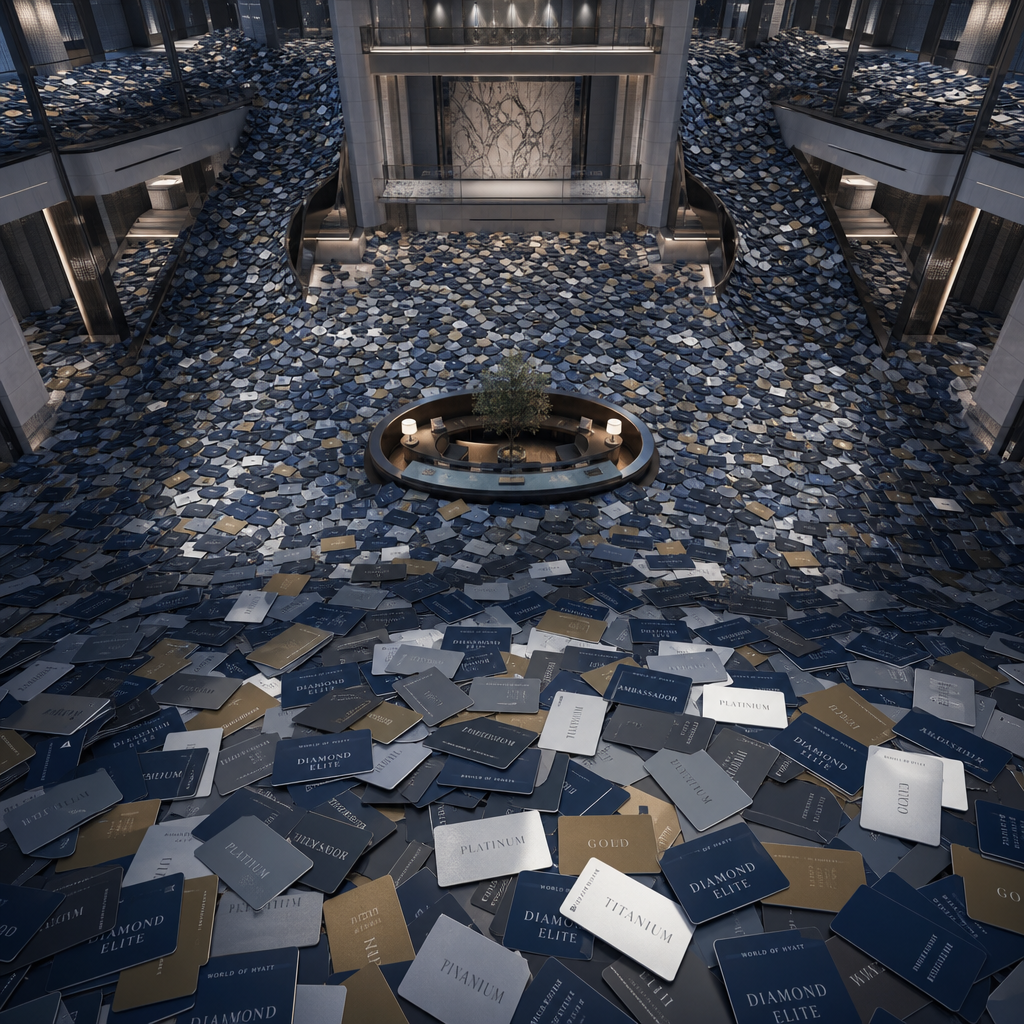
When thirty million people hold the same elite status, the word elite begins to lose its meaning. When every hotel in a chain is required to deliver a standardised version of recognition — the welcome amenity on the desk, the upgrade if available, the envelope with the hand-written note that was not hand-written — the ritual becomes protocol. Protocol is not recognition. It is the performance of recognition, which is a different thing entirely, and which the guest who travels with intention will detect almost immediately.
Hilton Honors operates with similar ambition. Its portfolio stretches from Hampton Inn to Conrad and Waldorf Astoria — a span so wide that the programme must somehow serve the point-collecting road warrior and the guest who has chosen a Waldorf in the Maldives in the same breath. The points themselves are generous; the earning is straightforward; the top tier — Diamond — is attainable enough that it carries the uncomfortable suggestion of ordinariness. This is the paradox of mass-scale loyalty: the more accessible the status, the less it confers.
IHG One Rewards faces a version of the same challenge. Its luxury tier — Six Senses, Regent, InterContinental — is genuinely distinguished. Six Senses, in particular, has built an identity so specific and considered that a loyalty programme feels almost beside the point. The guest who travels to a Six Senses in the Maldives or the Douro Valley does not arrive for points. They arrive for the particular silence that the brand has learned to construct. IHG holds these properties within a programme that also covers Holiday Inn Express, which creates a cognitive dissonance that neither end of the portfolio can entirely escape.
Radisson Rewards, now absorbed into Choice Hotels following the 2022 acquisition, tells its own cautionary story. A programme that once served a coherent identity — business hotels, northern European efficiency, a certain Nordic understatement — found itself folded into an American system built around highway-adjacent lodging and redemption simplicity. What was lost in the merger was not the points. It was the coherence of the offer. The programme now spans Radisson Collection (boutique, design-forward, European) and Comfort Inn (airport proximity, free breakfast). These are not the same guest. They are not, strictly speaking, the same aspiration.
III. The Clarity Model
Against this backdrop, the approach taken by GHA DISCOVERY reads as a considered refusal.
The Global Hotel Alliance is, in structural terms, different from the chains described above. It is not a hotel company. It is an alliance — a consortium of independent hotel brands that have chosen to share a loyalty infrastructure while retaining their individual identities. Its portfolio includes Anantara, Capella, Kempinski, Corinthia, Leeu Collection, NH Collection, and over fifty others. The properties are independent in spirit; the programme is the connective tissue.
What GHA chose to build, and what distinguishes it sharply from its competitors, is a currency with a declared value.
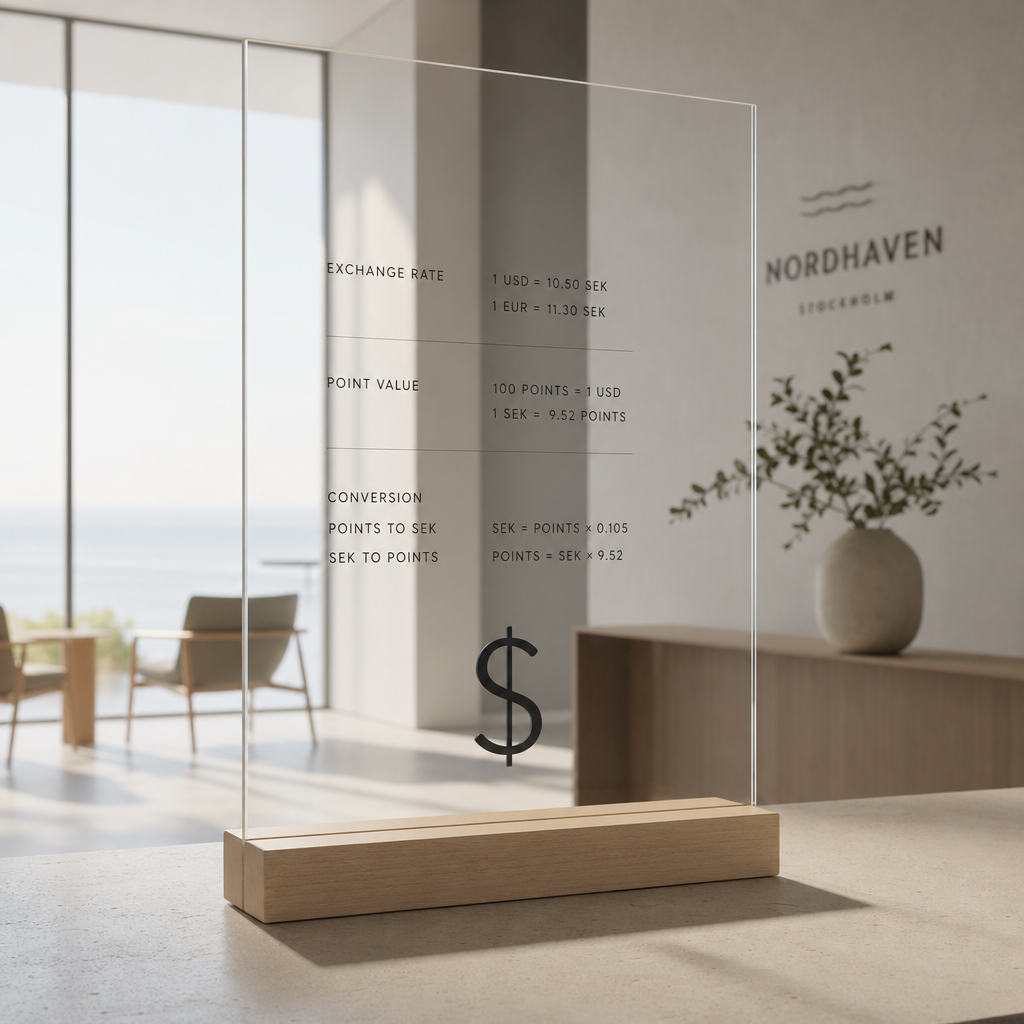
D$1 equals USD 1. Always. The DISCOVERY Dollar does not fluctuate with redemption category, does not depreciate in off-peak periods, does not require a conversion table to understand. One dollar earned is one dollar that can be spent — at the spa, at the restaurant, against a future stay. The programme does not ask you to calculate. It asks you to spend.
This sounds simple because it is simple. The fact that it is unusual in this industry says something significant about the industry's relationship with its guests. A loyalty currency whose value is opaque — which describes virtually every major hotel points programme — is a loyalty currency designed, at least in part, to obscure. The redemption complexity of Marriott Bonvoy, for instance, is well-documented: award nights that vary by date and category, point values that range from impressive to negligible depending on the property and the night. The guest who masters this system is rewarded. The guest who does not is quietly disadvantaged.
GHA's answer — transparency as a form of respect — resonates beyond its practical utility. It suggests a model of membership that does not depend on the guest's confusion. A survey of 9,000 GHA members, conducted in partnership with Bond Brand Loyalty in 2026, found that clarity and flexibility ranked above discounts as the primary drivers of programme preference among those who chose independent hotel loyalty programmes over the chains. Preferred for their clarity, flexibility, and meaningful travel experiences over traditional models built around rigid points systems.
The numbers support the argument. In 2025, GHA DISCOVERY generated USD 3.2 billion in total revenue across its portfolio — a 21 per cent increase on the year prior. More tellingly, repeat stay revenue reached USD 1.8 billion, suggesting that guests who discover the model tend, on balance, to return to it. Cross-brand stay revenue — guests who booked a second GHA property under a different brand than where they enrolled — surged 15 per cent to USD 424 million. These are not the metrics of a programme people tolerate. They are the metrics of one they choose.
The portfolio is smaller — 1,000 hotels across 100 countries, compared to Marriott's 8,000+ — but the narrowness of the offer is, for its target guest, a feature rather than a limitation. The guest who stays at a Capella in Singapore or an Anantara in Vietnam has already made a specific choice. They are not looking for the hotel that will be there wherever they land. They are looking for the hotel that will remember them when they return.
IV. The Emotional Turn
In April 2026, Hyatt's chief executive said something that was either brave or absurd, depending on where you sit. He suggested that World of Hyatt guests should form an emotional attachment to the programme — that the relationship between a guest and their hotel company should be something more than the ledger of nights and points.

The reaction on frequent-traveller forums was predictably sceptical. We give them money and expect benefits, one commenter wrote. Insanity.
And yet.
World of Hyatt is, by most objective measures, the programme that comes closest to delivering on the aspiration. Its luxury portfolio — Park Hyatt, Alila, the Unbound Collection — is coherent in a way that Marriott's and Hilton's are not. Park Hyatt, in particular, has built an identity around a specific kind of guest: one who values a smaller lobby, a quieter bar, a staff-to-guest ratio that permits actual attention. The programme's award chart — which it retains when others have abandoned theirs — still offers nights at Park Hyatt properties at rates that feel genuinely generous. The earning is slower, the credit card ecosystem less developed, the path to elite status less frictionless. But for the guest who believes that loyalty should mean something beyond the accumulation of a fungible currency, World of Hyatt comes closer than most.
Accor Live Limitless occupies a different position — geographically concentrated in Europe and Asia, structurally complex, encompassing everything from ibis Budget to Raffles and Fairmont. Its top tier — Diamond — unlocks suite upgrades, executive lounge access, and weekend breakfasts at properties where breakfast is an event rather than a formality. The programme is better understood as a European sensibility applied to a global network: an emphasis on the pleasures of the table, on the particular quality of a Fairmont afternoon tea, on the Raffles bar at six in the evening when the light comes through the shutters at a particular angle.
What Accor has understood, more clearly than some of its competitors, is that the luxury guest does not want to earn. They want to be invited. The language of the programme — Live Limitless — reaches toward something beyond the transactional, even if the mechanics beneath it are still, at root, a points system with tiers and expiry dates.
V. The Status Inflation Problem
There is a moment in the life of every loyalty programme when the elite tier becomes too large to be elite. When the upgrade that was once a surprise becomes an expectation. When the private check-in that was once reserved for the most frequent guests is extended to anyone with a co-branded credit card. When the letter Diamond or Platinum or Ambassador appears on so many keycards that it has ceased to function as a signal.

This moment has passed, for most major programmes. It passed some time ago.
The response of the programmes has been to add new tiers above the existing elite levels — to create Platinum Elite and then Titanium and then Ambassador, to extend the ladder so that there is always a rung above the one you have reached. This solves nothing. It simply postpones the inflation while creating a new bureaucracy of status, a new set of thresholds to cross, a new reason to count the nights.
The guest who travels with genuine discernment — who has already given years and thousands of nights to a programme — often arrives at the top tier with a quiet disillusionment. The upgrade rarely materialises. The late checkout requires a negotiation. The welcome amenity is a plate of fruit that has clearly been prepared in bulk. The promise of recognition has been scaled until it no longer fits any individual.
This is not cynicism. It is observation. And it points toward something that the programmes, for all their data, have not fully resolved: the difference between knowing who a guest is and knowing who they are.
VI. The Houses That Do Not Count
There are hotels that have no loyalty programme. They are worth noting, because their absence is a position.
Aman has no programme. You are not a member of Aman; you are a guest. The distinction matters. The repeat guest at an Aman property is recognised through the staff's institutional memory — through notes kept across seasons, through a front desk manager who has learned that you prefer your evening meals at a specific hour and that you do not like your room to be serviced until after eleven. This is recognition that cannot be scaled. It can only be cultivated.
Four Seasons does not have a traditional points programme; it has a preference system — a quiet infrastructure of knowledge about its returning guests that does not express itself as currency. It expresses itself as the champagne that appears before you have asked for it, as the room that faces the courtyard rather than the street because someone noted it in your profile from three years ago.
Rosewood has built a programme — Rosewood Connections — but it is less a loyalty scheme than a membership in a particular sensibility. There are no tiers. There is no status to chase. There is only the offer of recognition — the promise that the house has paid attention.
These models are not scalable. That is their point.
What they suggest is that the highest form of hotel membership is not a programme at all. It is a relationship. And relationships cannot be automated, templated, or distributed to thirty million cardholders simultaneously.
VII. The Question Behind the Card
We carry the cards because we want to be known. This is not a commercial observation — it is a human one. The desire to arrive somewhere and be recognised, to be addressed by name before you have introduced yourself, to have a room that corresponds to a preference you once mentioned without expectation — this is a desire that precedes the hospitality industry and will outlast it.
The loyalty programme is an attempt to industrialise that desire. To create, at scale, the feeling that a small hotel in a city you love has always given you when the owner opens the door and says welcome back.
Some programmes come closer than others. GHA DISCOVERY's commitment to clarity signals a respect for the guest's intelligence. World of Hyatt's quieter, slower ambition signals a commitment to a particular quality of guest relationship. The absence of a programme at Aman or in the way Four Seasons operates signals something more radical: that some houses have decided the relationship itself is more valuable than the system.
But underneath all of it — underneath the D$ and the Bonvoy points and the Hilton Honors Diamond and the card that arrives, or doesn't arrive, in the post — is the same request.
Remember me. Not my category. Not my tier. Not the number of nights I have given you.
Me.
The answer to that request determines what kind of house you are running. It always has.