I. The Curtain
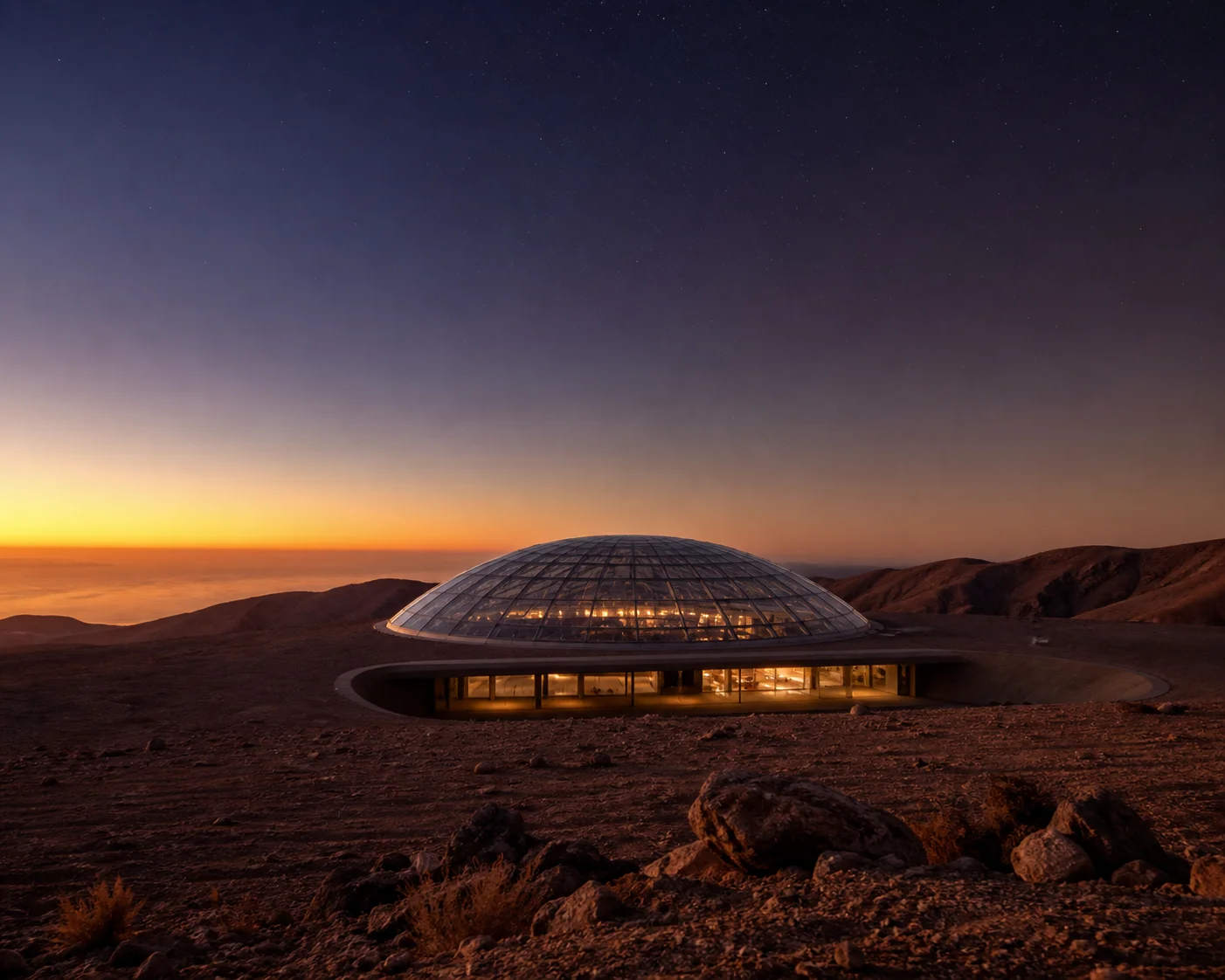
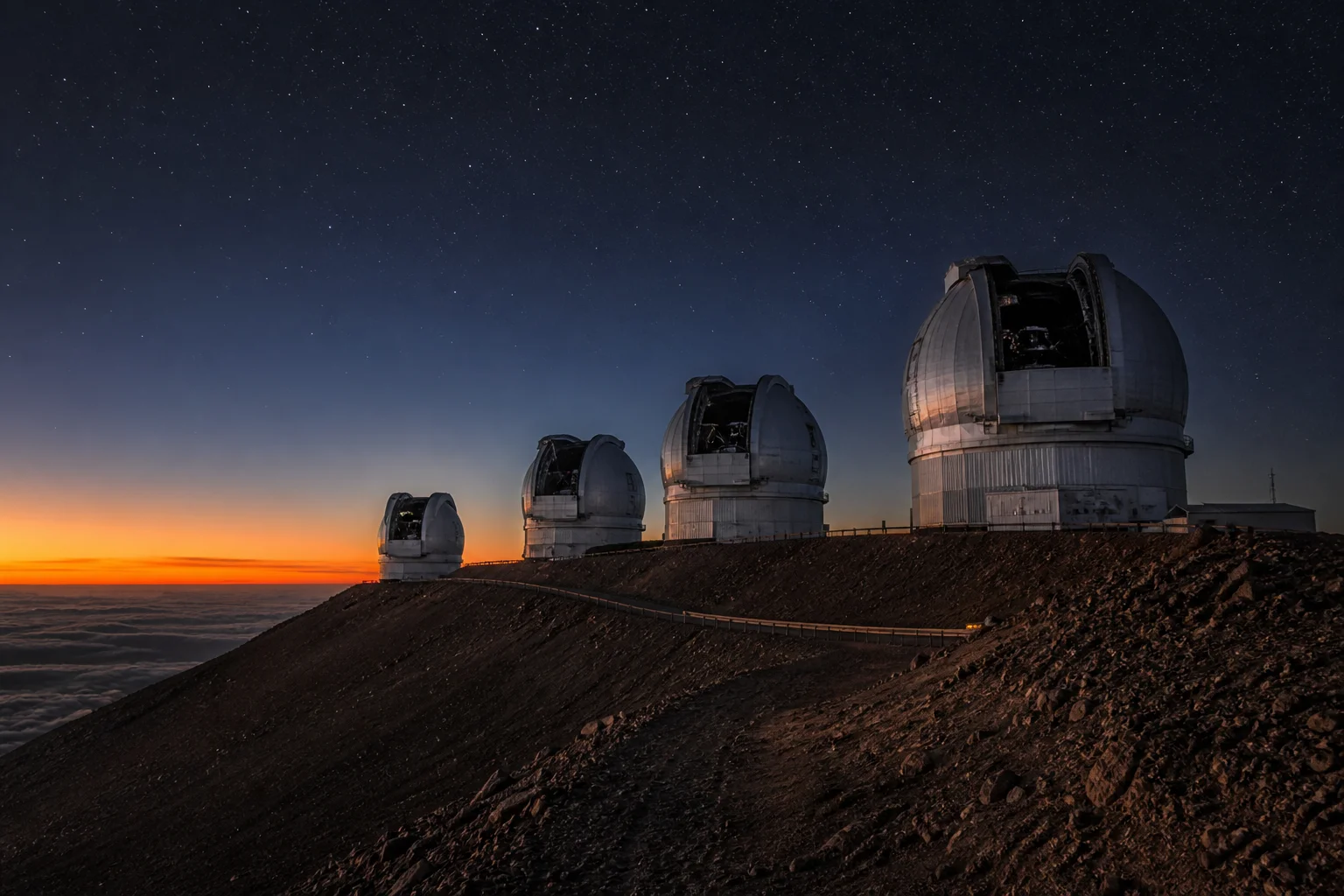
At sunset, a blackout curtain unfolds beneath a thirty-five-metre dome on a Chilean mountaintop. It moves without sound. No one watches it close. Its purpose is not to keep something out, but to keep something in: the light of human habitation, which here, at 2,635 metres above the driest ground on Earth, would constitute a form of trespass.
The building beneath the dome is called the Residencia. It belongs to the European Southern Observatory at Cerro Paranal, and it houses the scientists who operate four telescopes, each with a mirror eight metres wide, pointed at a sky so transparent that the atmosphere barely intervenes between instrument and origin. The Residencia was designed by Auer+Weber of Munich and the Chilean architect Hernán Marchant. It is four storeys deep. Most of it is buried. Its exterior walls match the colour of the surrounding terrain so precisely that from the access road, the structure is nearly invisible.
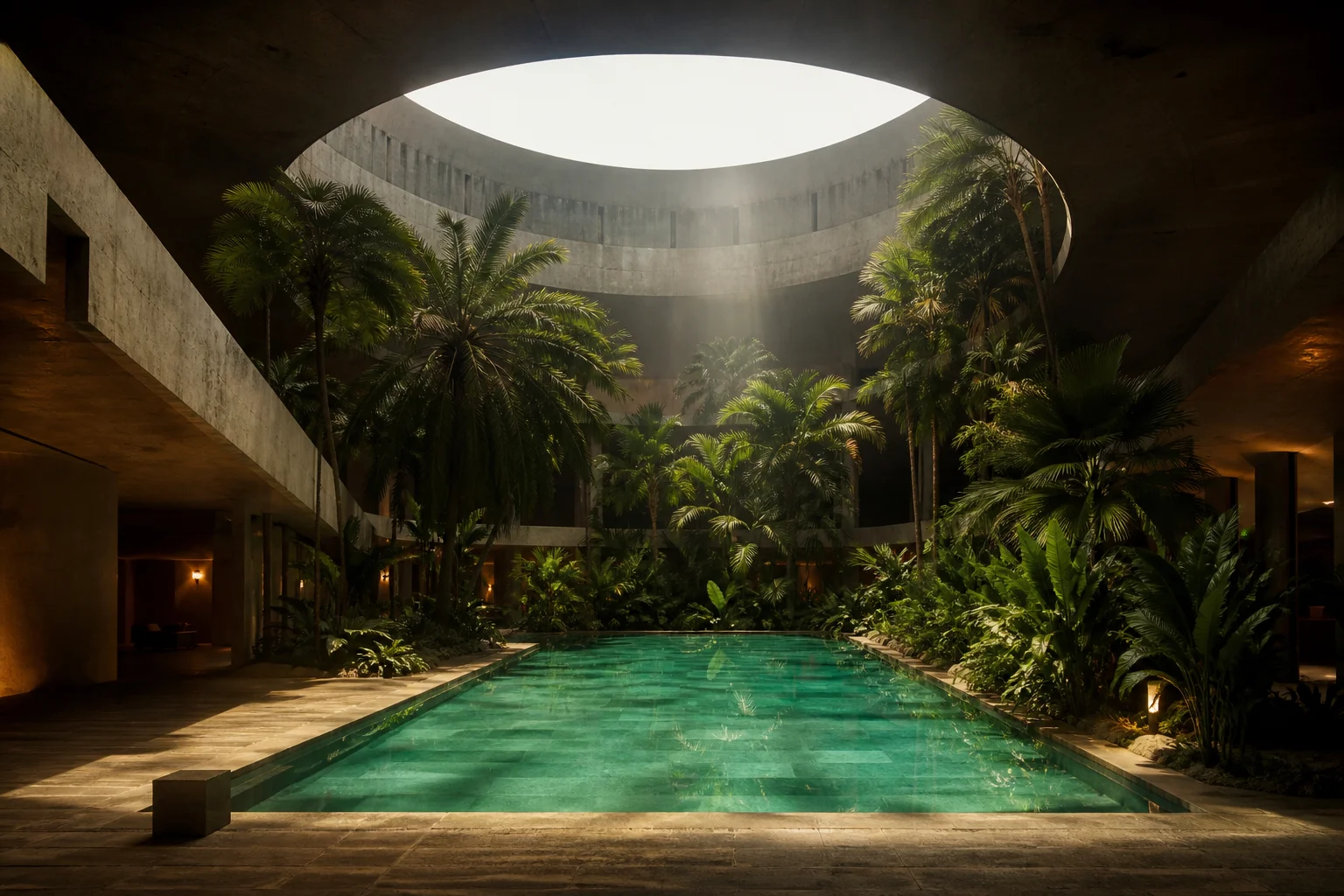
Inside: a tropical garden. A swimming pool. Moist air circulating through corridors cut into rock. The building exists as a life-support system for bodies that have spent twelve-hour shifts in conditions no organism was designed to sustain. It is, in the plainest architectural sense, an oasis. But its deeper logic is one of withdrawal. The Residencia does not assert itself against the landscape. It removes itself from the landscape's primary function, which is not geological. It is optical.
The desert exists, here, to be looked through.
II. The Listening
Forty kilometres east of San Pedro de Atacama, on the Chajnantor plateau at five thousand metres, sixty-six antennas face the sky. They do not look. They listen.
ALMA, the Atacama Large Millimeter/submillimeter Array, receives radiation from the cold universe: the space between stars, the dust that precedes formation, the gas clouds where galaxies began to coalesce less than a billion years after everything started. Its frequencies are too long for the eye. They belong to the register between infrared and radio, a bandwidth the human body cannot perceive and the atmosphere, in almost every other place on Earth, absorbs before it arrives.
Not here. The air above Chajnantor contains so little moisture that these waves pass through it almost without resistance. The plateau was chosen not for what it offers, but for what it lacks. Humidity. Cloud. Turbulence. The electromagnetic noise of civilisation. ALMA's site is defined by absence.
In 2025, the CRISTAL survey used ALMA to resolve the internal structure of galaxies observed as they appeared one billion years after the beginning. Cold gas. Dust. Clumpy star formation in objects so distant that their light has been travelling for twelve billion years. The instrument did not photograph these structures. It decoded their thermal whisper.
The array is closed to visitors. There is no public access, no viewing platform, no interpretive centre. ALMA does not perform its knowledge for an audience. It simply receives.
III. The Dark Constellations
The Lickan Antay, the people of the Atacama, have lived in this territory for millennia. Their astronomical tradition does not begin with stars.
It begins with their absence.
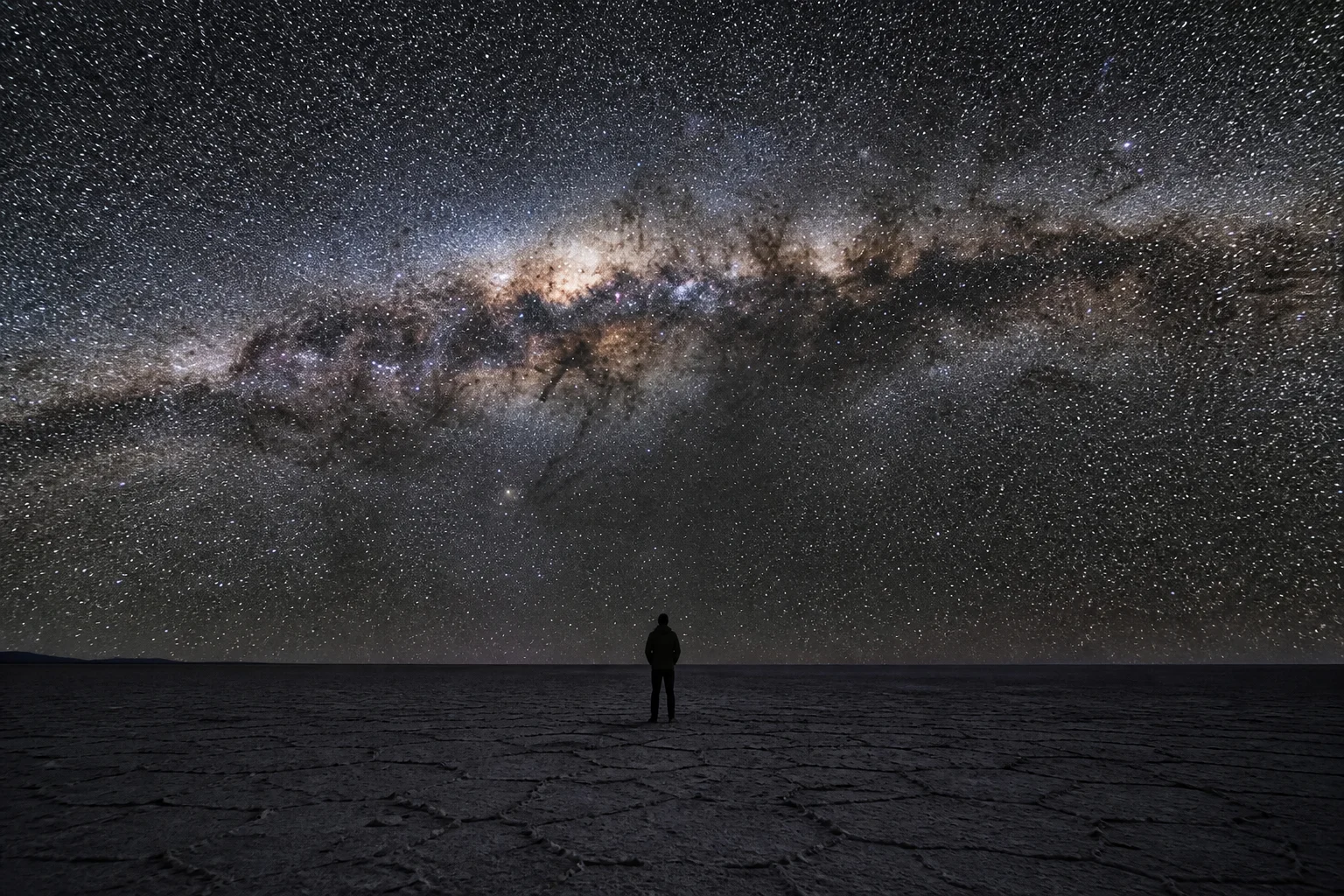
Where Western astronomy connects points of light into figures, the Lickan Antay read the dark lanes of the Milky Way: the dense clouds of interstellar dust that block the light behind them. These are theconstelaciones oscuras. The figures are not drawn in brightness. They are recognised in obstruction. A llama. A fox. A partridge. Shapes made not of presence, but of what refuses to let the light pass.
This is, if one is willing to see it, an entire cosmological inversion. The sky is not a scattering of signal against void. It is a field of luminosity interrupted by meaning. Darkness is not background. Darkness is architecture.
The astrophysicist Basilio Solís Castillo, himself Atacameño, works between these two systems: the academic and the ancestral. In June 2026, a Planisferio Astrodiálogos was launched in Toconao, a tool for reading the sky from within the territory, integrating memory, patrimony, and positioned observation. The sky above Chajnantor belongs to ALMA. The sky above Toconao belongs to a longer conversation.
IV. Legislating the Night
Chile is the only country on Earth that has legislated darkness.
The firstnorma lumínicawas enacted in 1998, the same year the Residencia's construction began and Germán del Sol completed the Explora lodge in San Pedro. It regulated exterior light emissions across the regions of Antofagasta, Atacama, and Coquimbo. Not for aesthetic reasons. For epistemological ones. Chile hosts approximately seventy per cent of the world's astronomical infrastructure. The sky is a national scientific asset.
In 2022, the regulation was expanded to cover the entire country. Its objects of protection now include not only observational astronomy, but biodiversity and human health. Cold white LEDs, with their high blue-spectrum content, are restricted. Twenty-nine communes in the northern regions have been formally declared areas of scientific and investigative value for astronomy.
And yet. In March 2025, DarkSky International raised concern over the INNA project: large-scale industrial infrastructure proposed kilometres from active observatories. Renewable energy, export capacity, economic logic. The darkness is not threatened by indifference. It is threatened by other urgencies.
Paulina Villalobos grew up in the Atacama. Her father, an amateur astronomer, would wake her for comets. She left for Santiago to study architecture. The stars vanished. "Just like people who come from the coast miss the ocean," she has said, "I missed the sky. "
She returned. Founded DIAV Lighting. Created Noche Zero, the first international event dedicated to the value of dark skies, held in San Pedro de Atacama. Sits on the board of DarkSky International. Her work is not against light. It is for the discipline of its restraint. Lighting design, in her formulation, is not the provision of visibility. It is the negotiation of what deserves to remain unseen.
V. Three Propositions of Emptiness
Three houses in the Atacama. Three architectural arguments about what it means to place a body in a landscape that resists inhabitation.
Germán del Sol's Explora (1998) borrows from pre-Columbian tradition: wide-span roofs offering shade, interiors whose modesty echoes the local farmhouse, a posture of horizontal settlement against the vertical drama of Licancabur. The lodge does not rise. It extends. Its observatory, with a sixteen-inch telescope and resident astronomers, is not an amenity. It is a claim: that observation is the appropriate mode of occupation here. You do not come to the Atacama to be entertained. You come to attend.
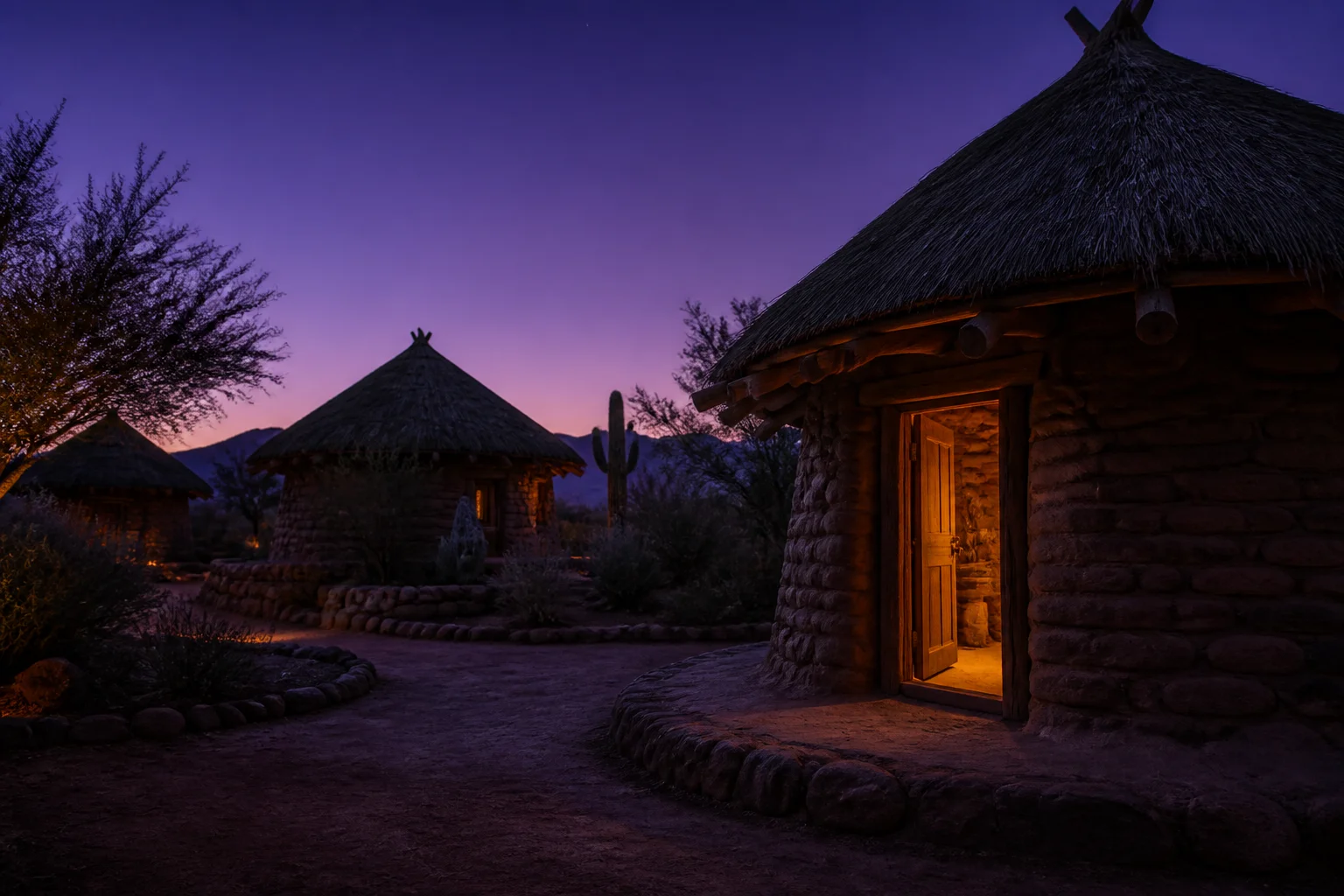
Awasi (2007), by Francisco Rencoret and Gonzalo Domínguez, draws on a deeper archaeology. Its round suites are built of stone, adobe, and thatch, inspired by the Village of Tulor, whose ruins two thousand years old lie just south of San Pedro. The material logic is circular, enclosed, almost monastic. Twelve rooms. A private guide assigned to each. Relais & Châteaux. Two Michelin Keys, the only property in the Atacama to hold them. Awasi does not make an architectural statement. It refuses one. The gesture is not assertion but disappearance: the building returns to the techniques of those who lived here long before architecture arrived as a discipline.
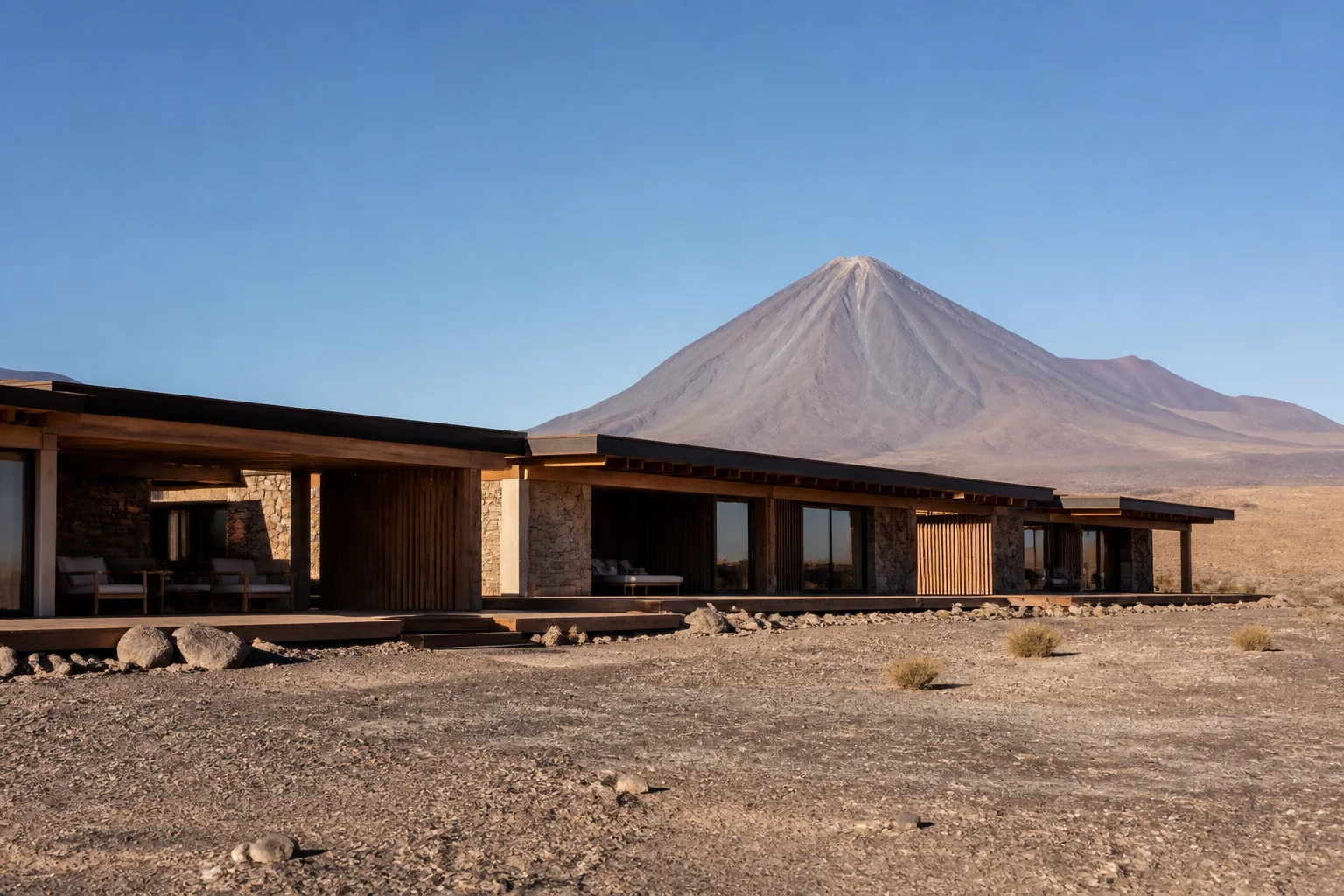
Tierra Atacama (2008) takes the modernist position. Thirty-two rooms of clean geometry facing the volcano. The building holds its own against the view. This is not modesty. It is confidence: that contemporary form, deployed with restraint and local material, can meet the landscape as an equal rather than a supplicant.
Three houses. None of them attempts to overcome the desert. Each, in its own syntax, concedes to it.
VI. After the Last Light
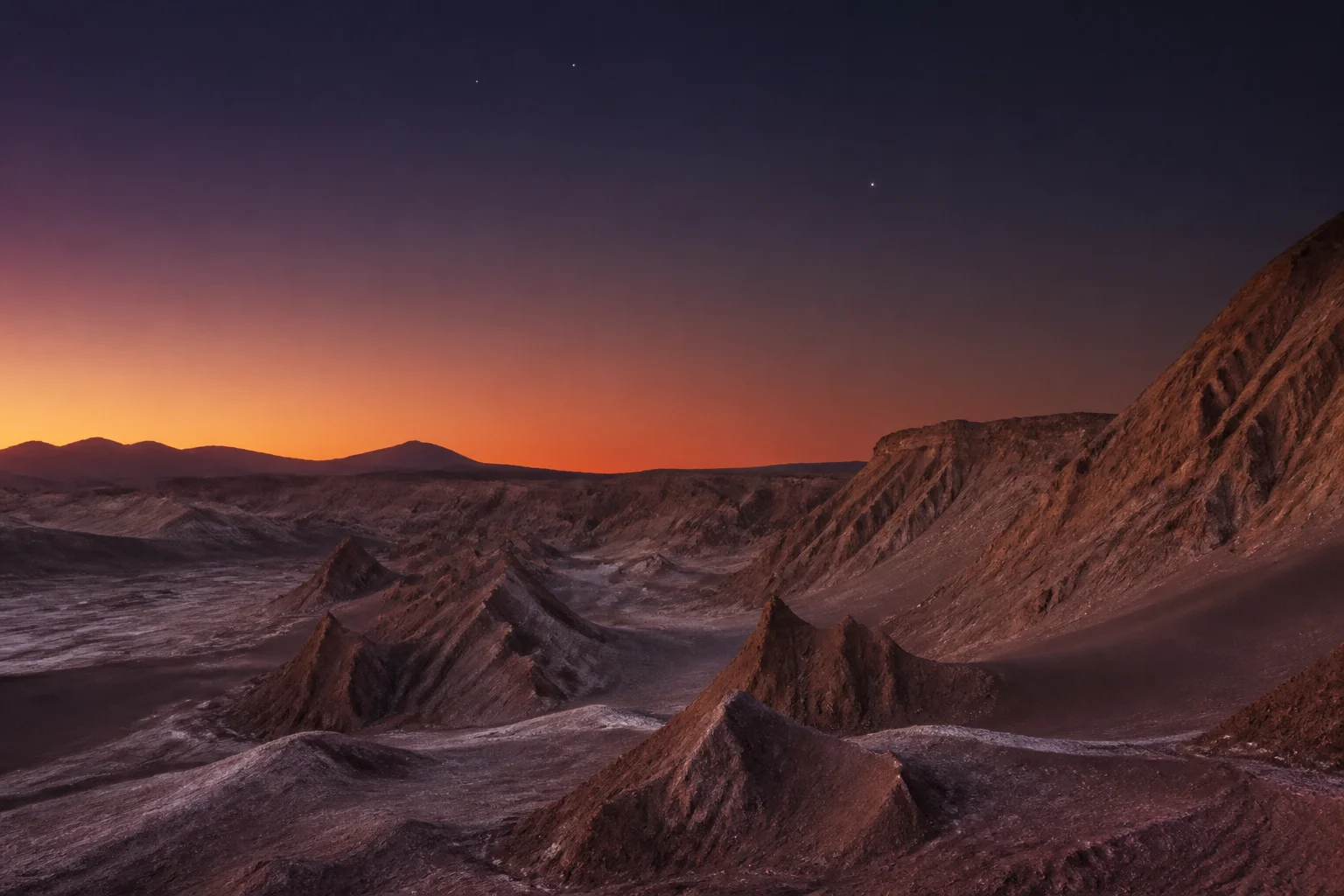
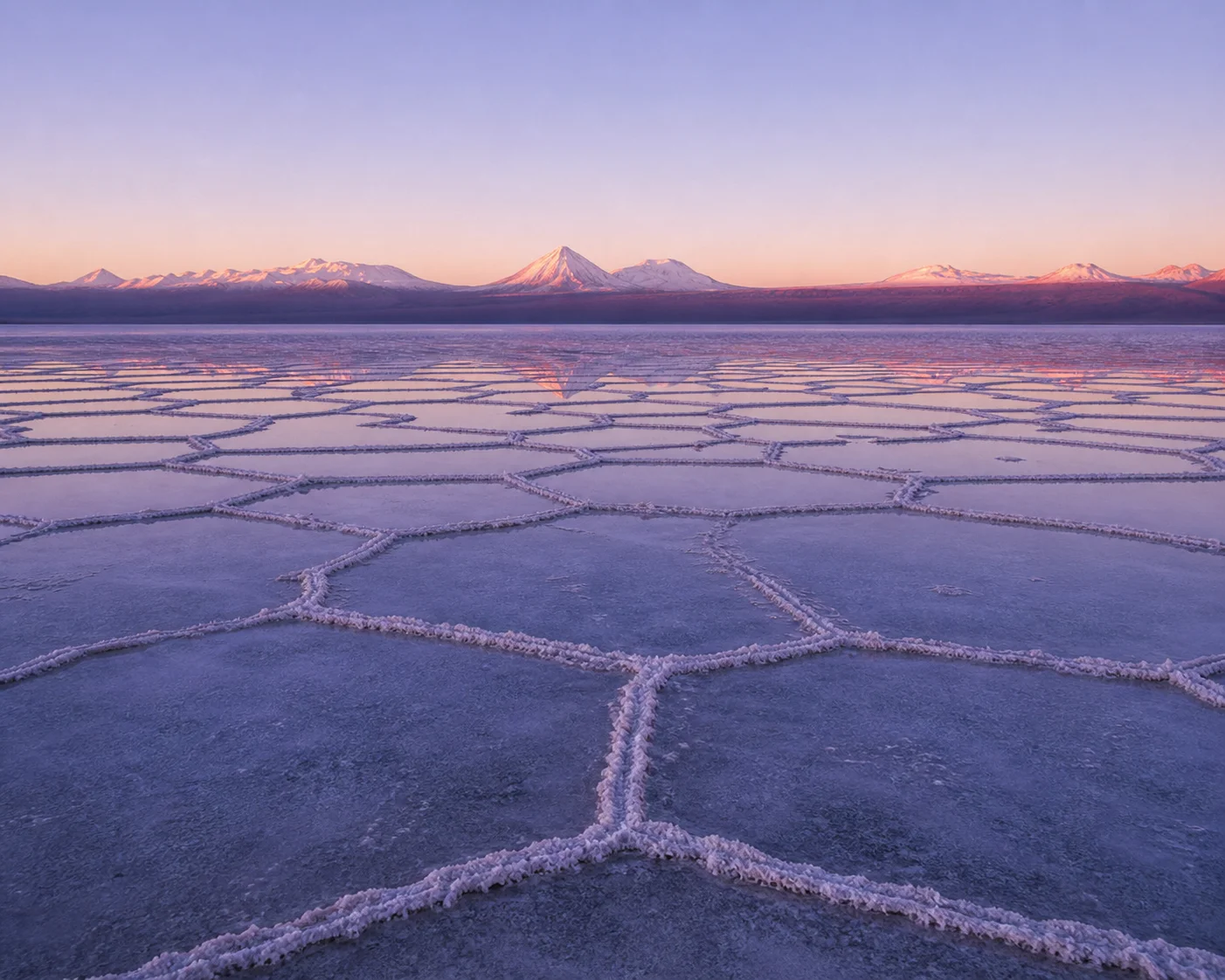
The Atacama has been dry for ten million years. Not decades. Not centuries. The geological record of its aridity predates the genus Homo by a factor of several thousand. The Andes rose and blocked the moisture from the east. The Chilean Coast Range sealed it from the west. The Humboldt Current cooled the Pacific air into a permanent inversion. Three mechanisms, operating across tectonic time, produced a landscape so stripped of water that NASA uses its surface to simulate Mars.
But the consequence that matters here is not geological. It is optical. The absence of moisture means the absence of atmospheric distortion. The absence of distortion means the sky becomes, for instruments and for the naked eye alike, almost infinitely deep. On a winter night in the Atacama, the galactic core passes directly overhead. The Bortle scale registers Class 1: the absolute zero of light pollution. Three hundred and forty clear nights per year. Humidity below twenty per cent.
This is not a destination. It is a condition.
And what the condition reveals is not primarily the stars. It reveals, by subtraction, what we have lost everywhere else. The thickness of our atmosphere. The noise of our presence. The accumulated glow of every city, highway, parking structure, and illuminated sign that, taken together, have made the sky, for most of the species, functionally opaque.
The Atacama does not give you darkness. It shows you that darkness was always there. That it is the original state. That light, not its absence, is the intrusion.
One does not visit such a place. One submits to it.