Escale Privée — Draft · Kyoto · Fushimi · Off season
Where red is not a colour, but a warning
One should arrive in Fushimi before Kyoto has decided whether it belongs to the day.
Not in the morning — earlier. In that uncertain hour when hotels still sleep behind paper walls, the Kamo River holds the last of the night, and the first trains cross the city with the discretion of people carrying someone else’s secret. The platform is cold. A vending machine releases hot tea with a metallic sigh. Someone adjusts a scarf. Someone else pretends they have not come here for the red.
And yet everyone comes for the red.
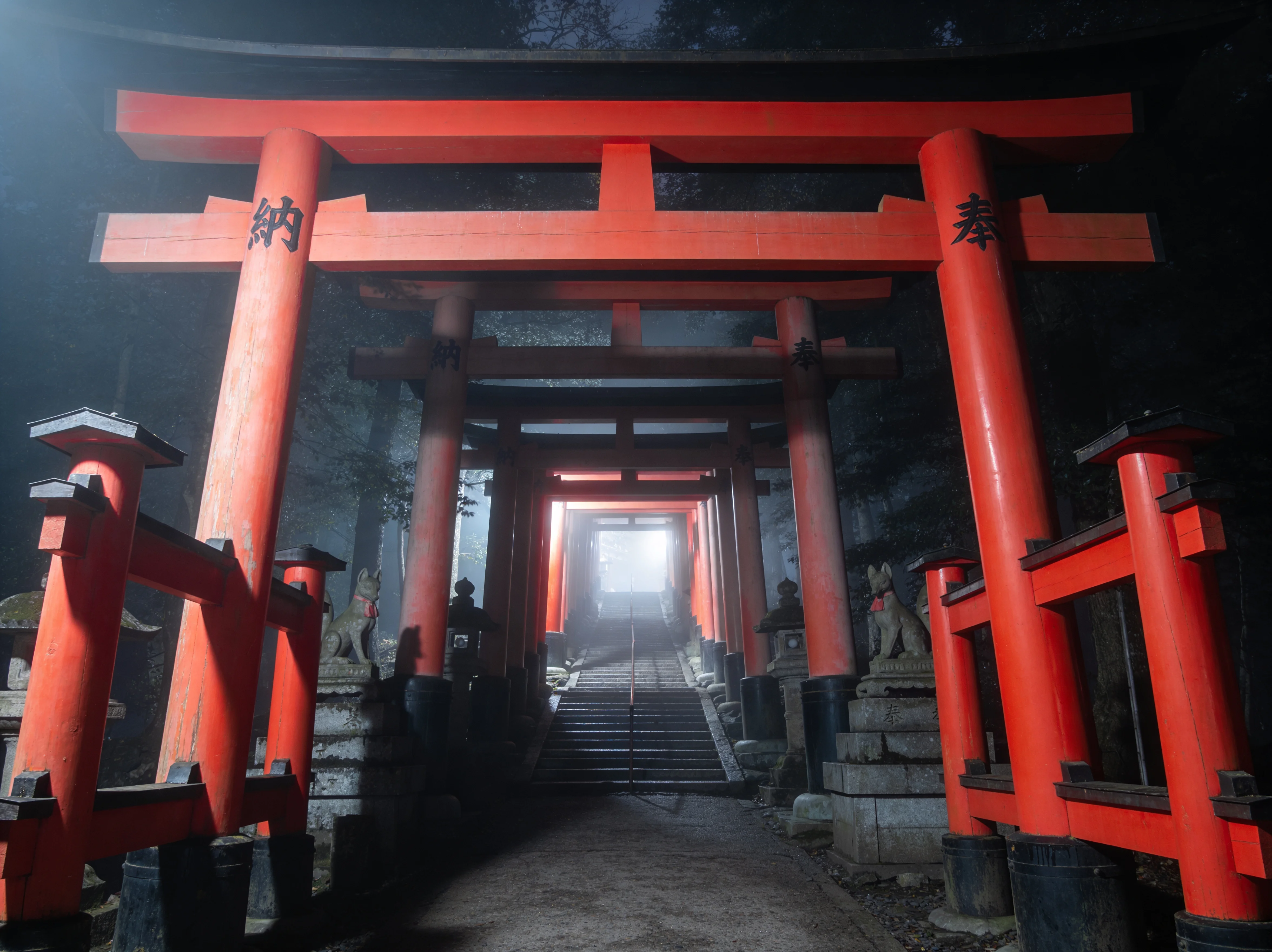
Fushimi Inari begins gently, almost too familiarly: stone, steps, shrine roofs, foxes at the entrance, the first torii in a colour every camera simplifies. Guidebooks speak of vermilion, of thousands of gates, of one of Japan’s most recognisable images. But off season — when damp clings to the wood and the forest has not yet filled with voices — the red stops being a view. It becomes a temperature.
It is not warm.
It is alive.
You pass beneath the first gate and something remains behind you. Not the city, not yet. Rather the part of yourself that comes to places asking them to confirm what photographs have promised. Fushimi does not confirm. Fushimi refuses. The further you walk, the less there is of Kyoto, and the more there is of something older: wood preserved against decay, names written in black characters, stone wet from the night, prayers suspended inside a passage.
The torii are not decoration. They are offerings. Each one is someone’s please or thank you. Someone brought here a desire, a fear, a business, an illness, the birth of a child, a first shop, a final hope. Someone paid for wood, pigment, inscription — for the possibility of placing a red threshold between the human and the divine. Now you walk through their private sentences, set one after another, so close together that light enters between them like breath.
Off season, one hears this more clearly.
One hears one’s own footsteps. The small strike of a drop against a leaf. A bird that remains unseen. And then — suddenly — a fox.
Not a living one. A stone one. Its mouth held in a tension somewhere between vigilance and irony. It carries a key, or a scroll, or something that looks less like an object than a secret. Officially, the foxes are messengers of Inari Okami — but not the foxes one might glimpse in the mountain. The true messengers are invisible white foxes, byakkosan. The stone ones are only substitutes. Visible traces of something that cannot be seen.
Perhaps this is why Fushimi seduces differently from the rest of Kyoto. Not through harmony. Through withheld access.
At Kiyomizu-dera, the view comes out to meet you. In Arashiyama, the bamboo arranges itself into a theatre of vertical lines. In Gion, evening has practised its grace. But Fushimi does something more dangerous: it leads you upward, repeating the same gesture until you are no longer certain whether you are walking through a forest, a shrine, or your own memory.
The legend begins with a transformation: a rice cake, an arrow, a swan, a mountain, rice growing where the bird came to rest. There is something exquisitely Japanese in this story — no hunger for explanation, only a passage from one state into another. Food into bird. Bird into omen. Omen into place. Place into a devotion that has lasted for thirteen centuries.
Thirteen centuries later, a person stands beneath the gates at dawn and pretends they have come to sightsee.
There is no need to reach the summit. This is one of the truths not said often enough. The luxury of Fushimi is not in completing the circuit. It is in recognising the moment when the mountain begins to speak more quietly — and in not silencing it with ambition. It is enough to step away from the main route, to pause beside a small altar where miniature torii stand tightly together like children’s prayers, or at a bend where the red darkens and the forest becomes almost black.
That is where the real Fushimi begins.
Not the one in photographs.
The one that cannot be taken away.
You descend differently. Not because you have seen something. Rather because you have been seen by something. Near the exit, shutters begin to rise. There is the smell of fried tofu, sweets, sauce, morning coffee, damp paper. Inari sushi and kitsune udon are more than local dishes here — tofu carries the echo of the fox, the edible shadow of the shrine’s own mythology.
But one should not remain too long at the shrine. Fushimi has another body.
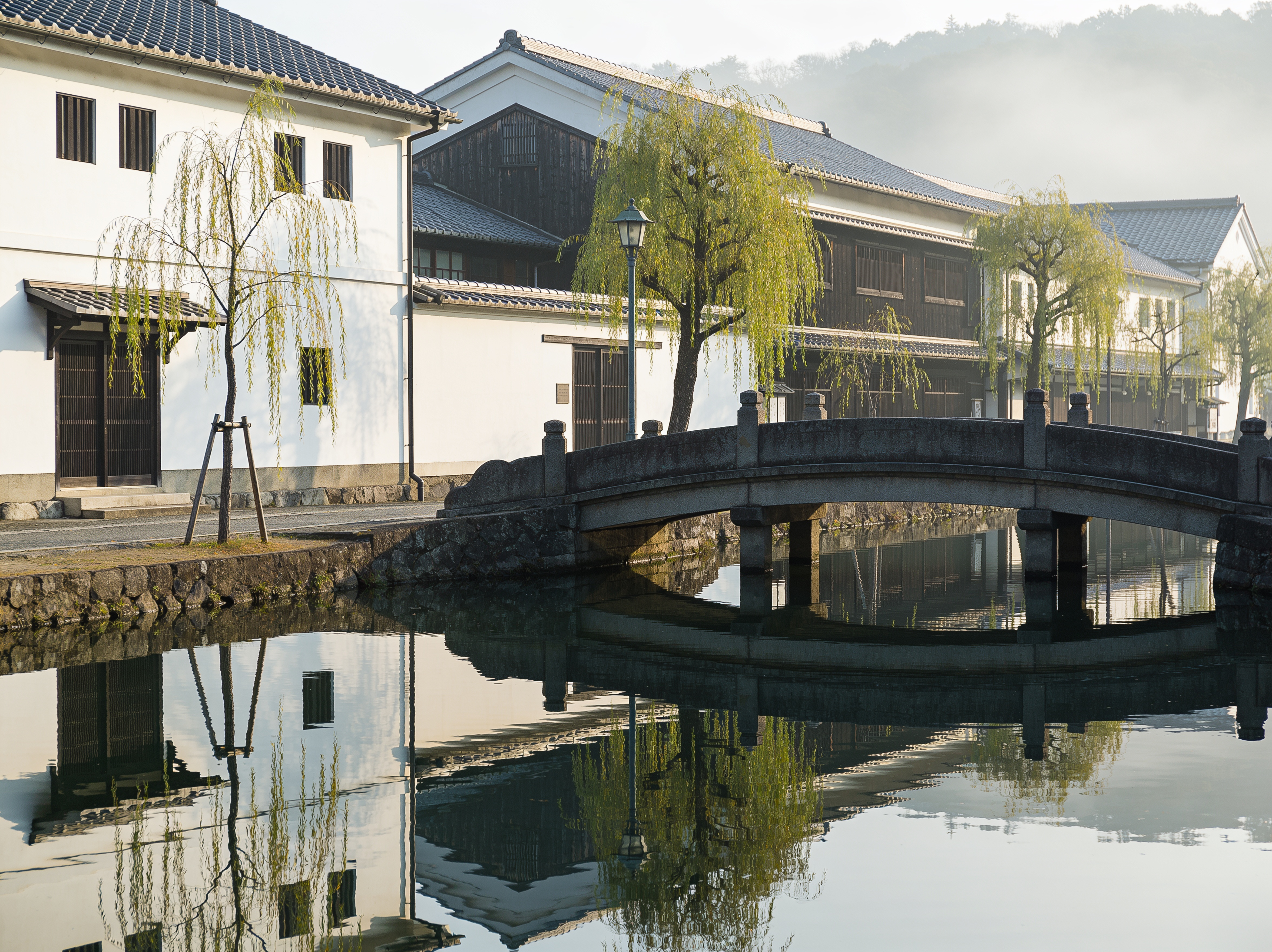
A few stations, a few streets, a shift in emphasis — and suddenly the red disappears, yielding to water. The sake district lies lower, quieter, as though after the shrine’s vertical tension the city requires something that moves horizontally. Fushimi’s canals do not have the spectacle of Arashiyama. They do not promise a grand view. They are more private: willow trees over water, white-plastered brewery walls, dark timber, small bridges, the silence of warehouses that have known, for generations, the rhythm of rice, steam and fermentation.
Here, Kyoto changes flavour.
Fushimi has the water from which sake is made — soft, subterranean, patient. Not water to be described, but water to be transformed. Rice into alcohol. Winter into scent. Labour into clarity. In the colder months, when winter brewing reaches its peak, the air may carry the aroma of steamed rice and fermenting moromi — not the smell of a restaurant, but of a process. Something alive, held inside wood and vats, invisible until it becomes liquid.
In Fushimi, even alcohol seems to have memory.
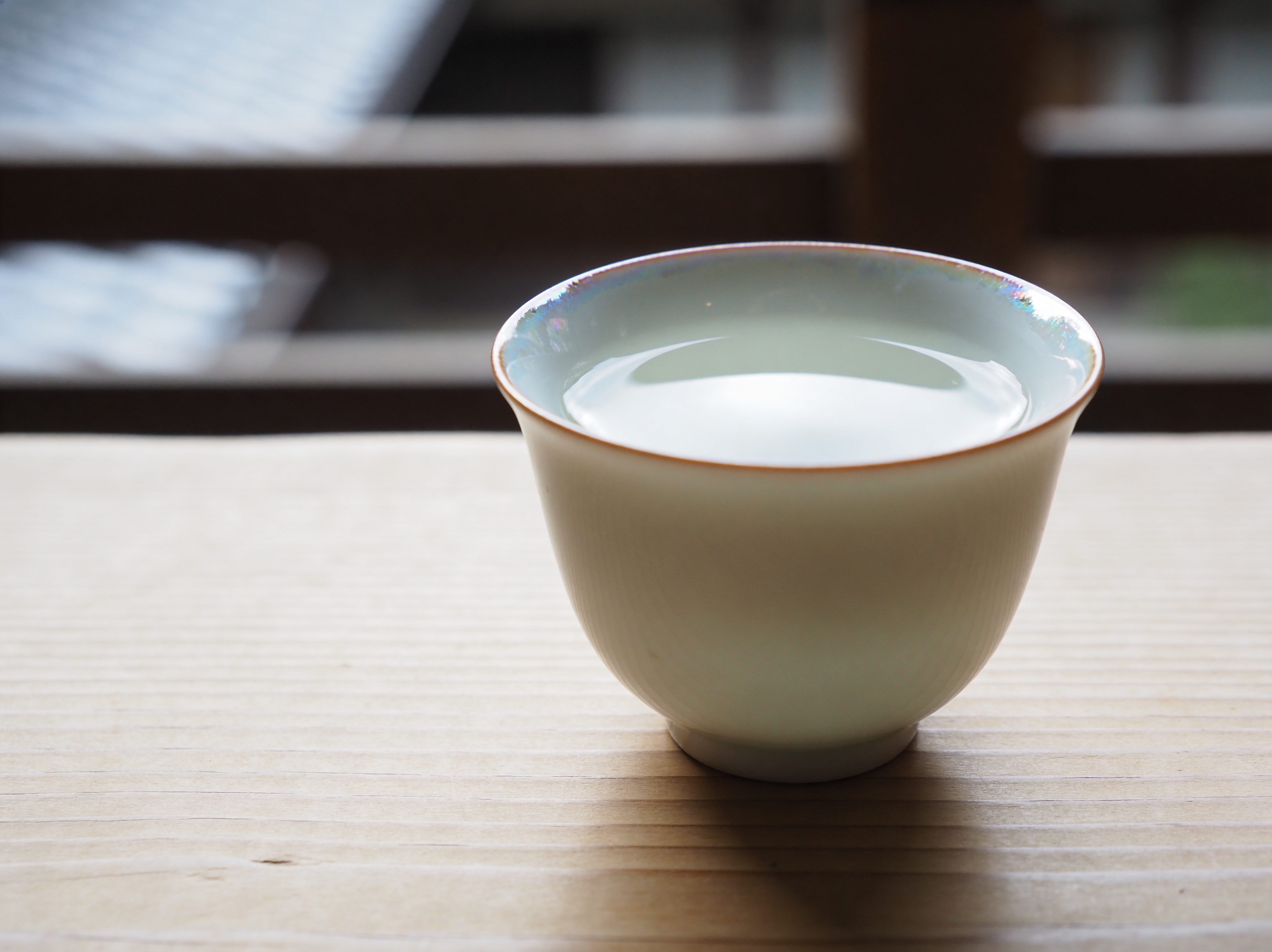
The Gekkeikan Ōkura Sake Museum can be treated as a museum, but it is better approached as an entrance into a language. Tools, barrels, old photographs, bottles, processes — everything speaks of simple things: rice, water, time, temperature, hands that knew when not to hurry. The tasting at the end should not feel like an attraction. It should feel like a closing line. A small cup, a cool brightness, a flavour so clean that for a moment it seems more water than alcohol.
And then one understands that Fushimi is not one district.
It is two prayers.
The first rises upward — through gates, forest, foxes, stones, red.
The second flows low — through canals, breweries, soft water, rice and glass.
One asks.
The other ferments.
Off season, there is space between them. Not the touristic kind, not filled with itinerary, but the real kind: a little cold on the hands, no queue, an empty place at the bar, a Jikkokubune boat moving along the canal outside the most obvious season of blossoms, restaurant doors still closed, soon to smell of broth. Kyoto without season is not empty. It is loosened. Like a kimono slipped from the shoulders and left over a screen.
Where to inhabit the silence
One does not need to sleep in Fushimi itself. Perhaps it is better not to sleep too close to the mystery. Fushimi requires arrival — a small ritual of distance.
Sowaka, in Higashiyama, holds something of the whisper after prayer: an old structure, a courtyard, a small number of rooms, a stone threshold after which the city becomes less certain of itself. It is an address for those who wish to return from Fushimi to wood, shadow and discreet elegance, rather than to hotel neutrality.
The Shinmonzen offers another kind of silence — more contemporary, precise, almost hidden along the water of Gion Shirakawa. Tadao Ando does not design a spectacle here, but restraint: material, light, river, nine suites, the feeling that luxury need not introduce itself.
Both addresses allow the most important gesture: to leave before dawn without theatricality, and to return after dark without needing to explain to anyone what has happened.
How to eat after Fushimi
After Fushimi, one should not eat loudly.
In the morning, something simple is enough: kitsune udon, a bowl of warm broth, a sweet made with red bean, rice wrapped in sweet tofu. Food should have softness after the descent. It should return the body after a place that, for a moment, asked more of it than admiration.
Later — sake. Not as a list, not as a flight, not as a collection of labels. Rather one cup, chosen for the coldness of the day. Fushimi tastes best without demonstration: lightly mineral, quiet, carrying the memory of water. If evening brings you back toward Gion, let dinner not compete with the day: tofu, kaiseki, tempura, a small counter where the gesture of the cook is more persuasive than the description of the menu.
Kyoto does not like to be consumed.
It likes to be noticed.
Off season
Off season does not mean less.
It means nearer.
Fewer people between you and the gate. Fewer voices between you and the water. Fewer photographs between you and the fox that looks out from stone as though it knows your intentions better than you do. Spring has its blossoms, autumn its maples, summer its heavy air. But Fushimi off season has something more difficult: the absence of ornament.
Then the structure of the place becomes visible.
Red.
Water.
Rice.
Wood.
Stone.
Passage.
Return.
And perhaps this is why Fushimi remains not as an image, but as a feeling one cannot immediately name. Something between unease and gratitude. As though one had passed through thousands of gates not in order to reach a shrine, but to understand that every true place is a threshold.
And some thresholds — if approached off season, before the light, without witnesses — open only slightly.
Enough.