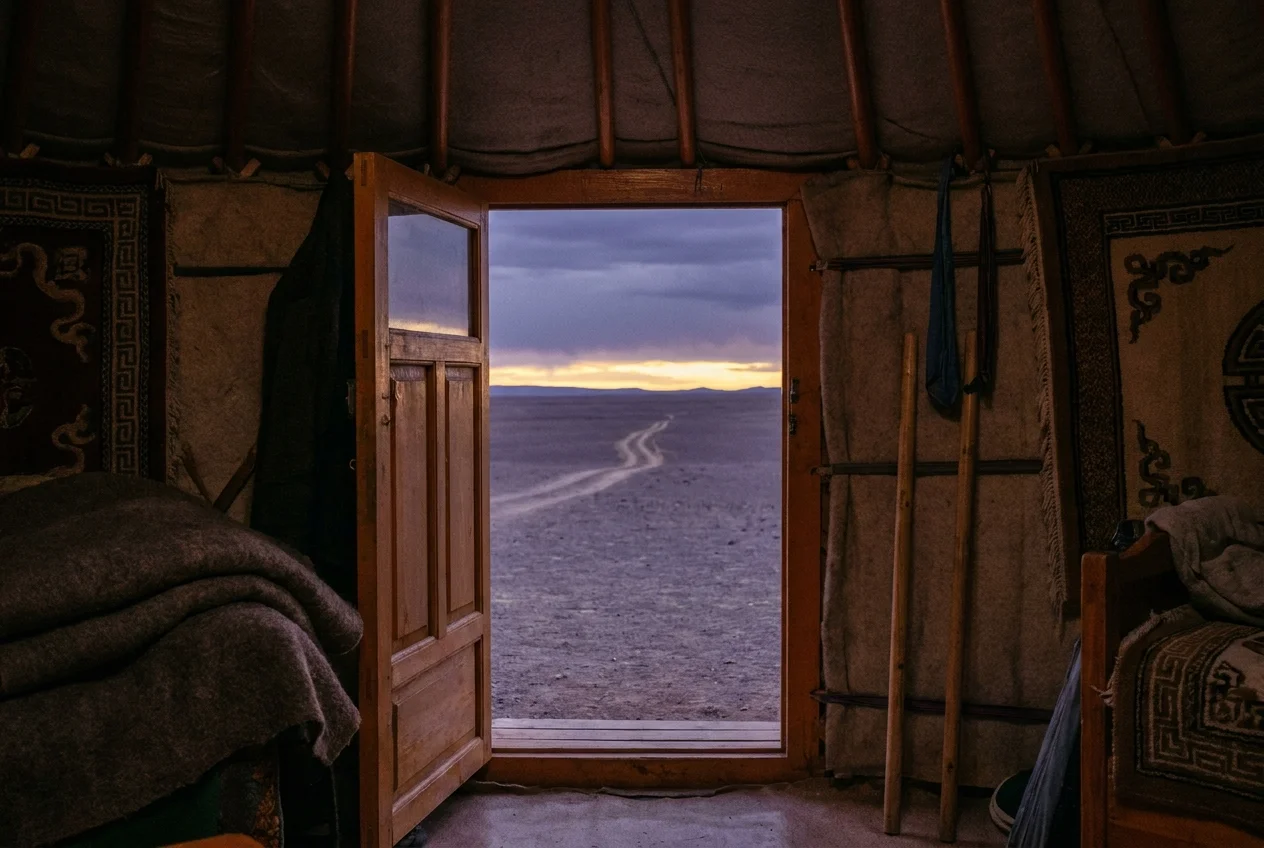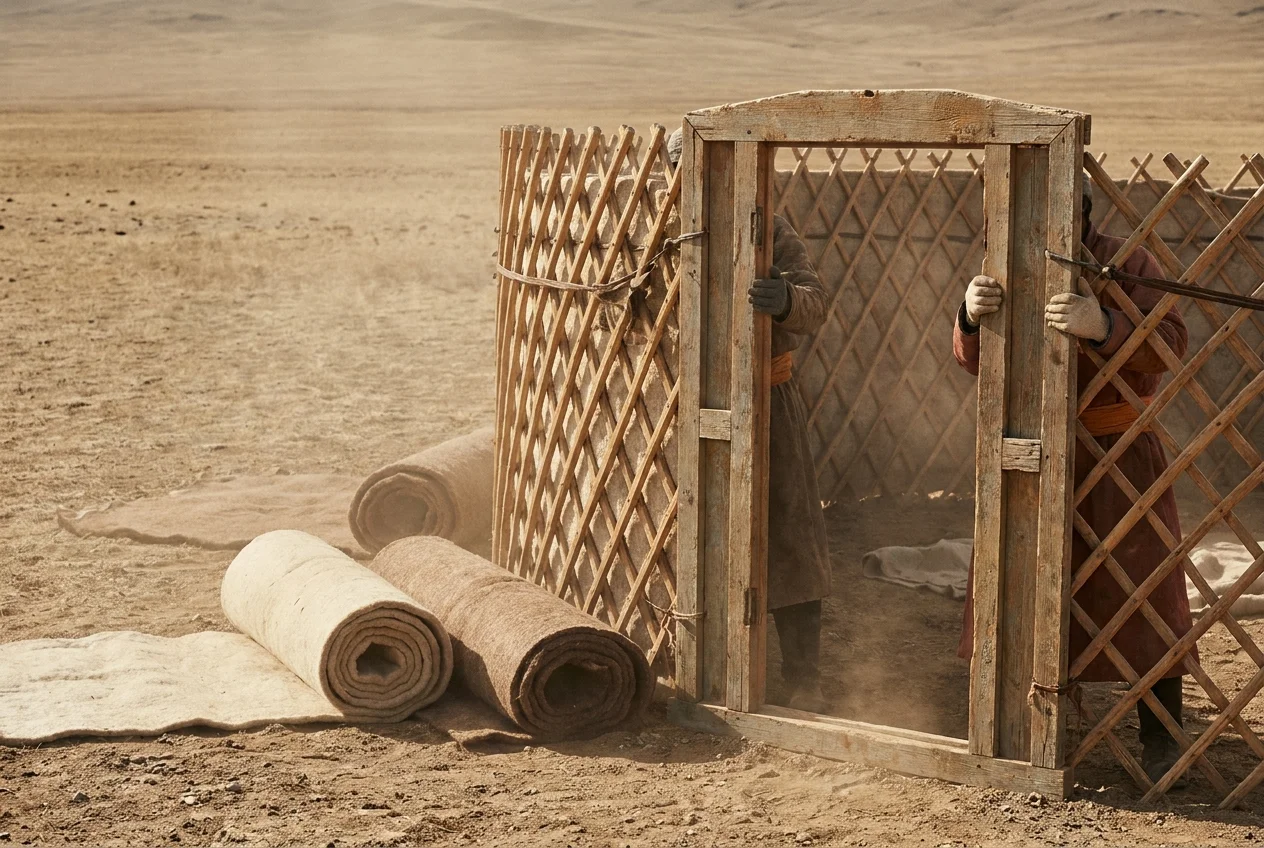
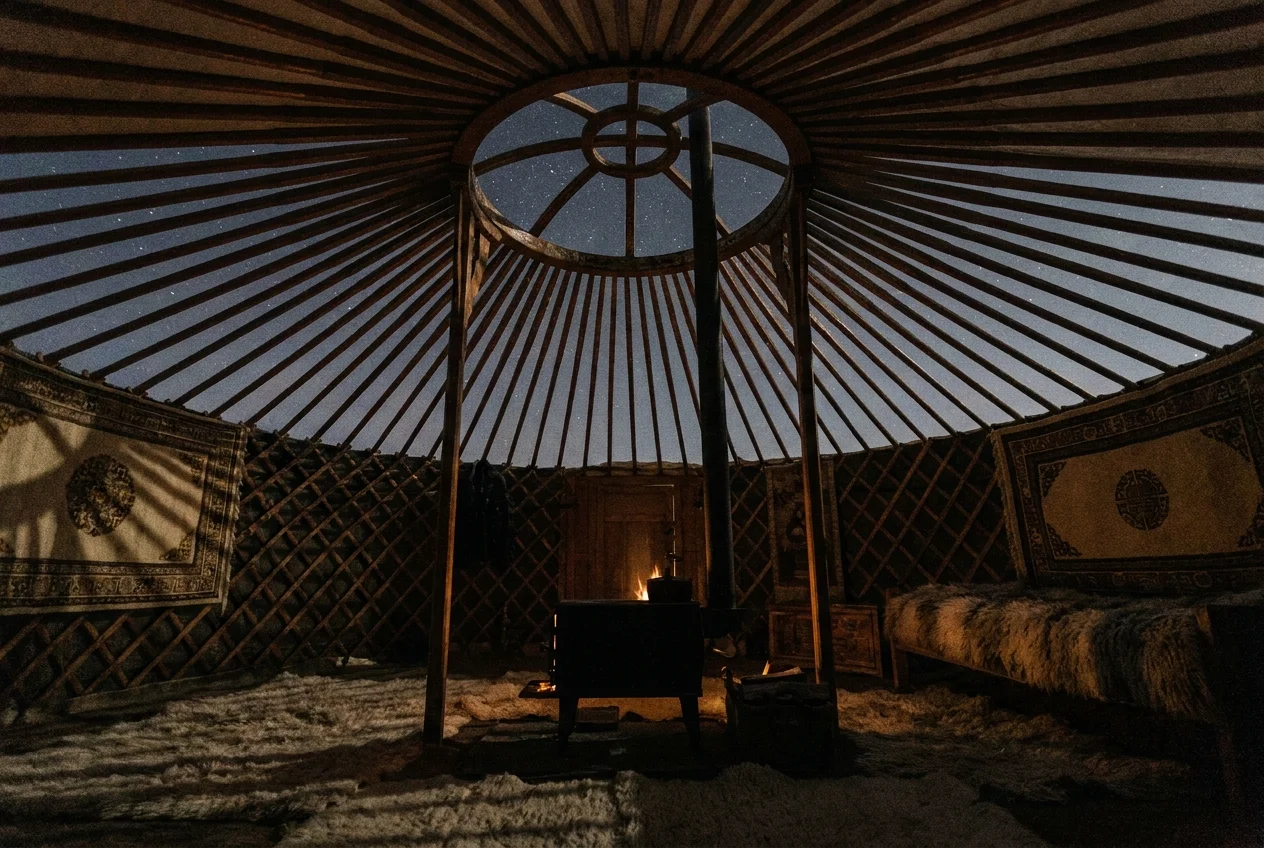
I. The door faces south.
A Mongolian ger is assembled around a wooden frame designed to move: lattice walls, roof poles, a circular crown and layers of felt and canvas. The entrance is traditionally oriented towards the sun and away from the coldest northern winds. Opposite it, in the northern quarter, sits the place of honour. At the centre, the stove establishes the practical and symbolic order of the room.
Nothing is incidental. Direction becomes shelter. Portability becomes resilience. Hospitality is built into the plan before a guest arrives.
For Escale Privée, this is where the Gobi begins—not as an empty landscape waiting to be consumed, but as a complete system of intelligence. The ger is architecture reduced to what matters: material, climate, movement and social code. It can be dismantled, transported and raised again because permanence here has never depended on staying still.
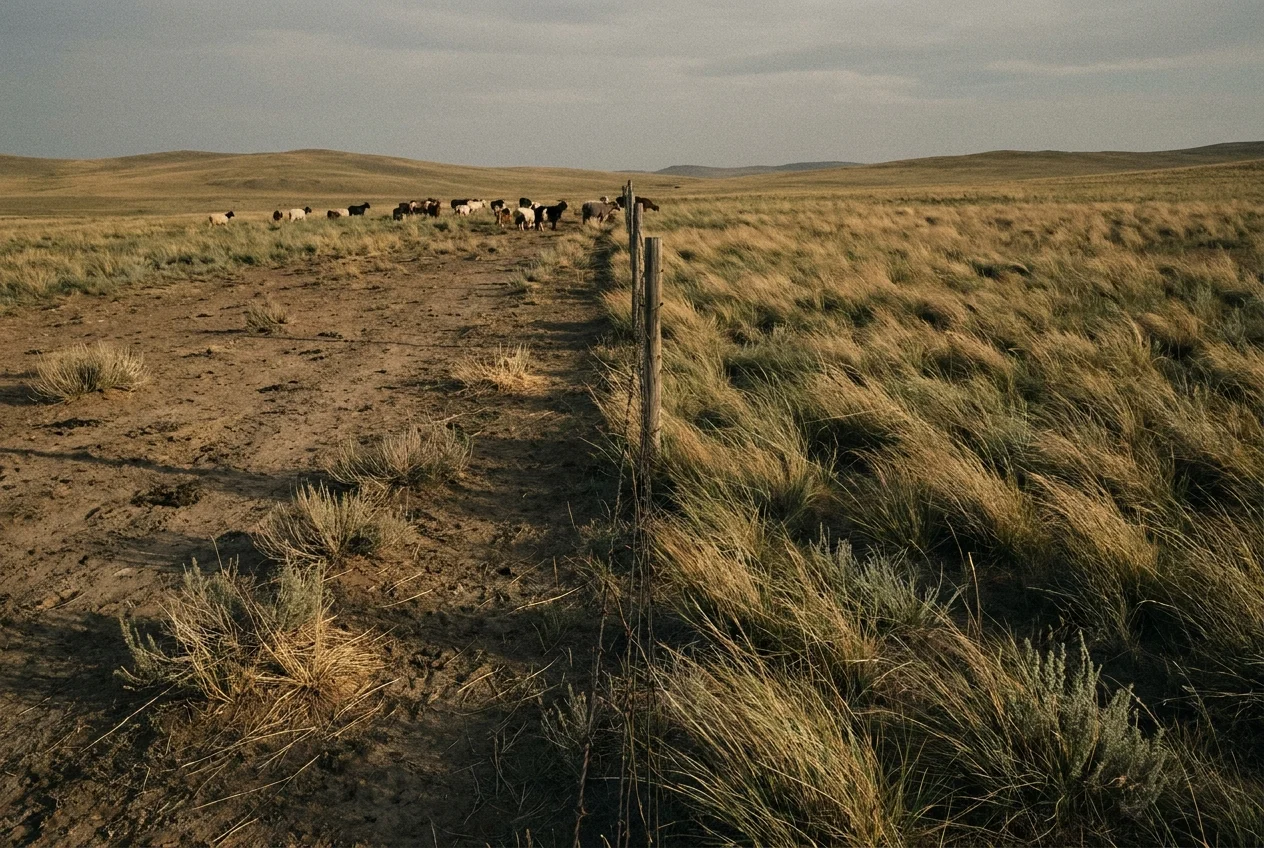
One usually enters the southern Gobi through Dalanzadgad, then continues overland on tracks that may barely register as roads. Beyond the town, distance changes character. The useful unit is no longer the kilometre but the interval between water, pasture, shelter and weather.
The landscape appears sparse. The knowledge required to inhabit it is not.
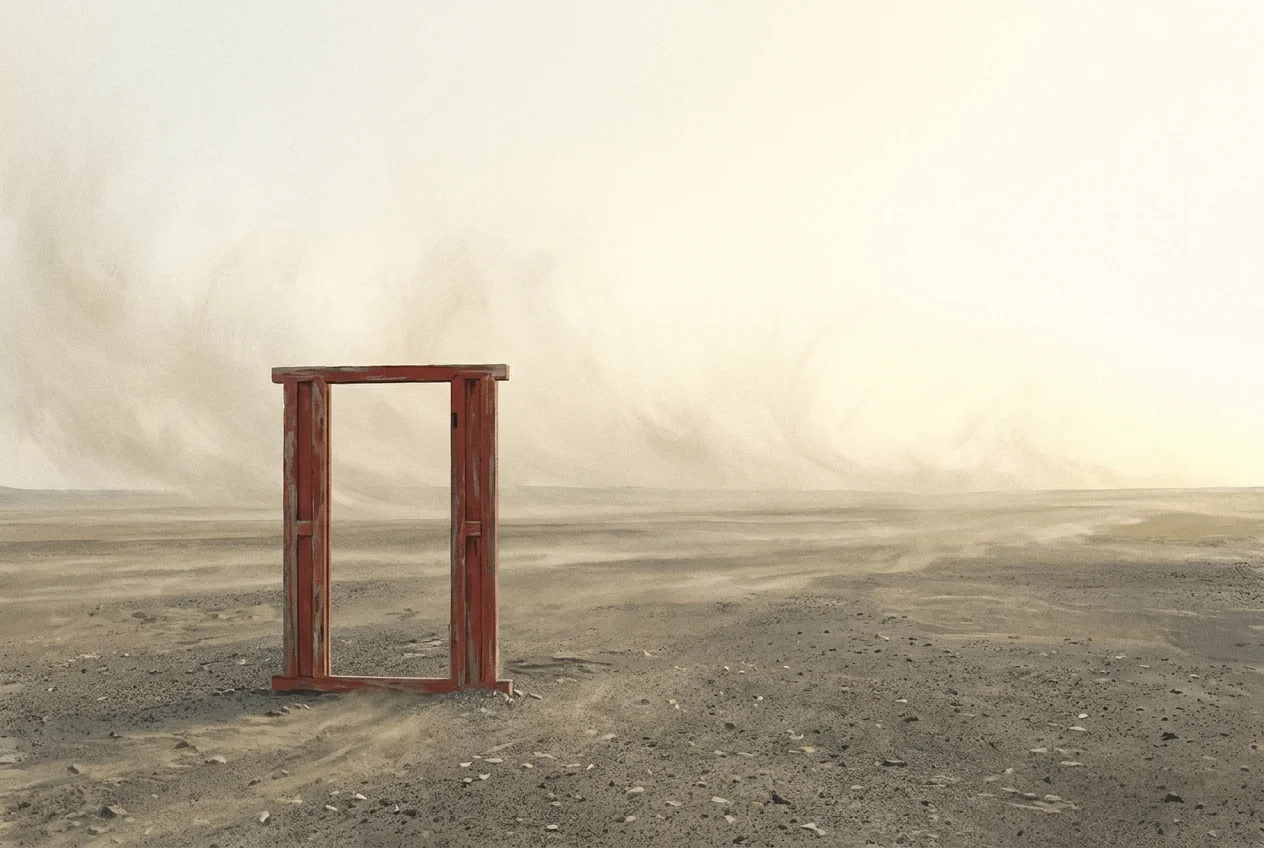
II. The Architecture of Movement
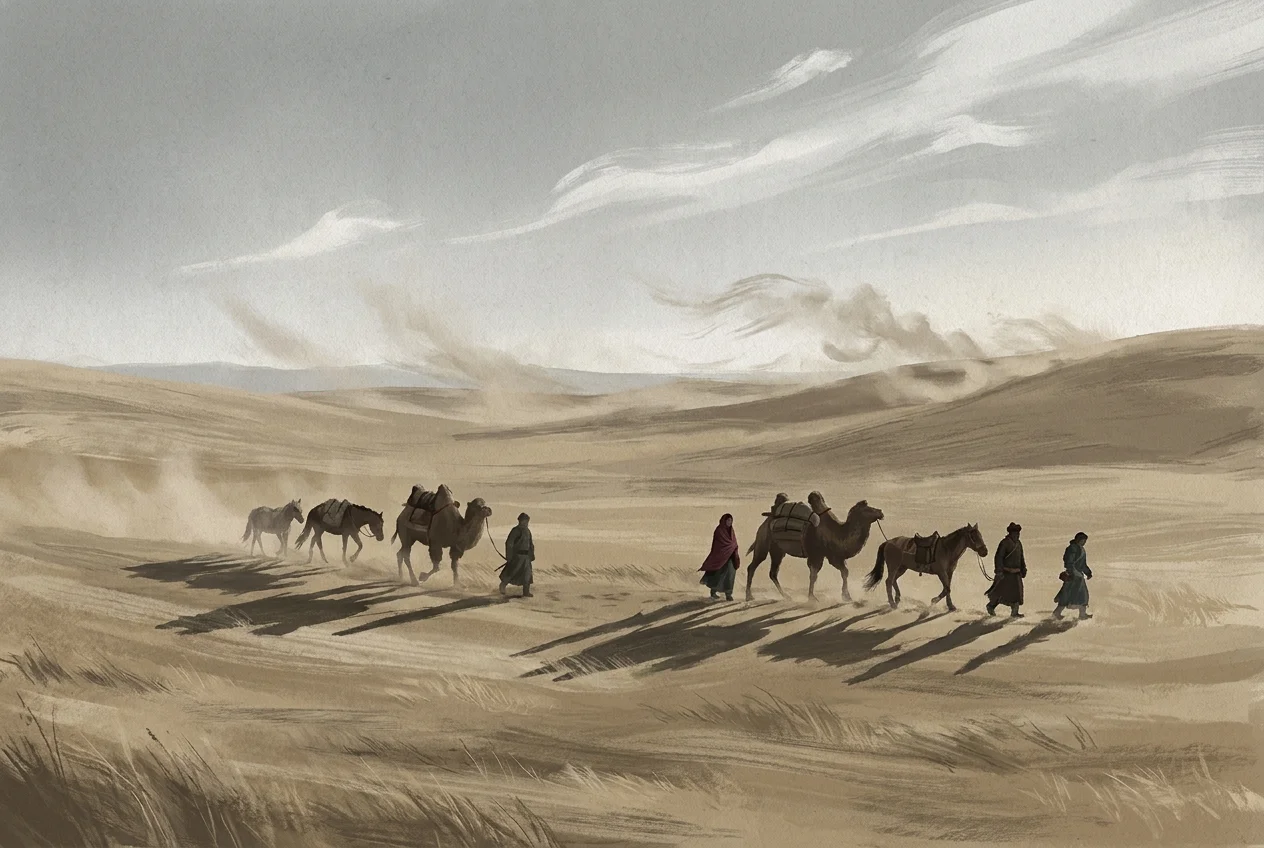
In 2024, UNESCO inscribed Mongol nomad migration and its associated practices on the Representative List of the Intangible Cultural Heritage of Humanity. Its description is precise: nomadic culture rests on the interdependence of pasture, livestock and herders. Families move according to grass, geography, climate and season, allowing used land time to recover.
This is not movement without structure. It is operational discipline.
Routes are remembered. Pastures are classified. The timing of departure matters. Every family member participates in preparing the household, animals and equipment. Children learn not only how to care for livestock, but how to read terrain and assemble the dwelling that makes mobility possible.
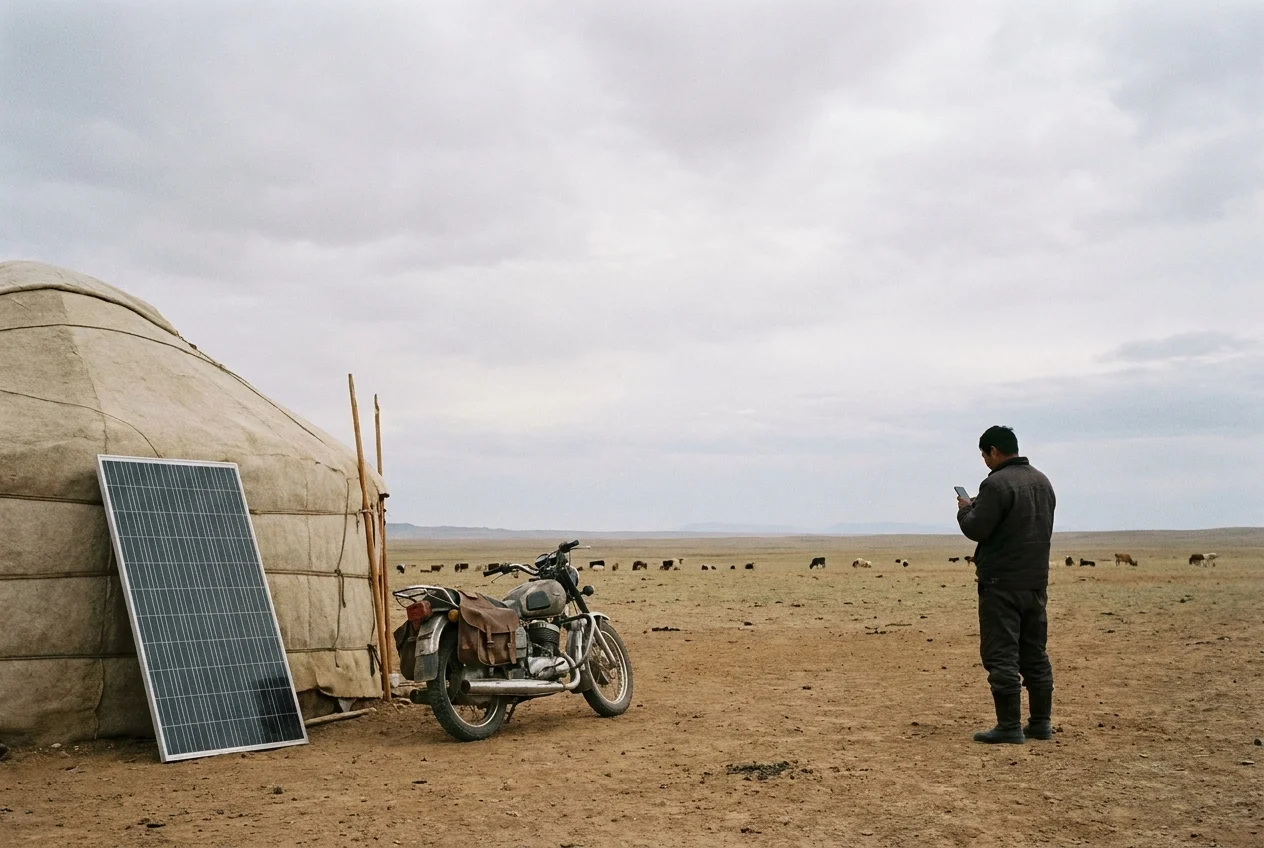
Modern tools have entered this system without fully replacing it. Solar panels stand beside gers. Motorcycles extend the daily radius of herd management. Smartphones deliver market prices and weather forecasts to places where physical infrastructure remains limited. The contrast is visually striking, but commercially it is familiar: technology increases efficiency while transferring new dependencies into a system that once held more of its knowledge locally.
A motorcycle saves time. A forecast reduces uncertainty. A mobile connection can improve access to buyers. Yet fuel prices, imported equipment, debt and weak connectivity introduce costs the older system did not carry.
The relevant question is therefore not whether nomadic life is becoming modern. It already is. The question is whether modernisation strengthens the autonomy of the people who manage the land—or merely makes them more legible to markets that remain elsewhere.
III. Nutag
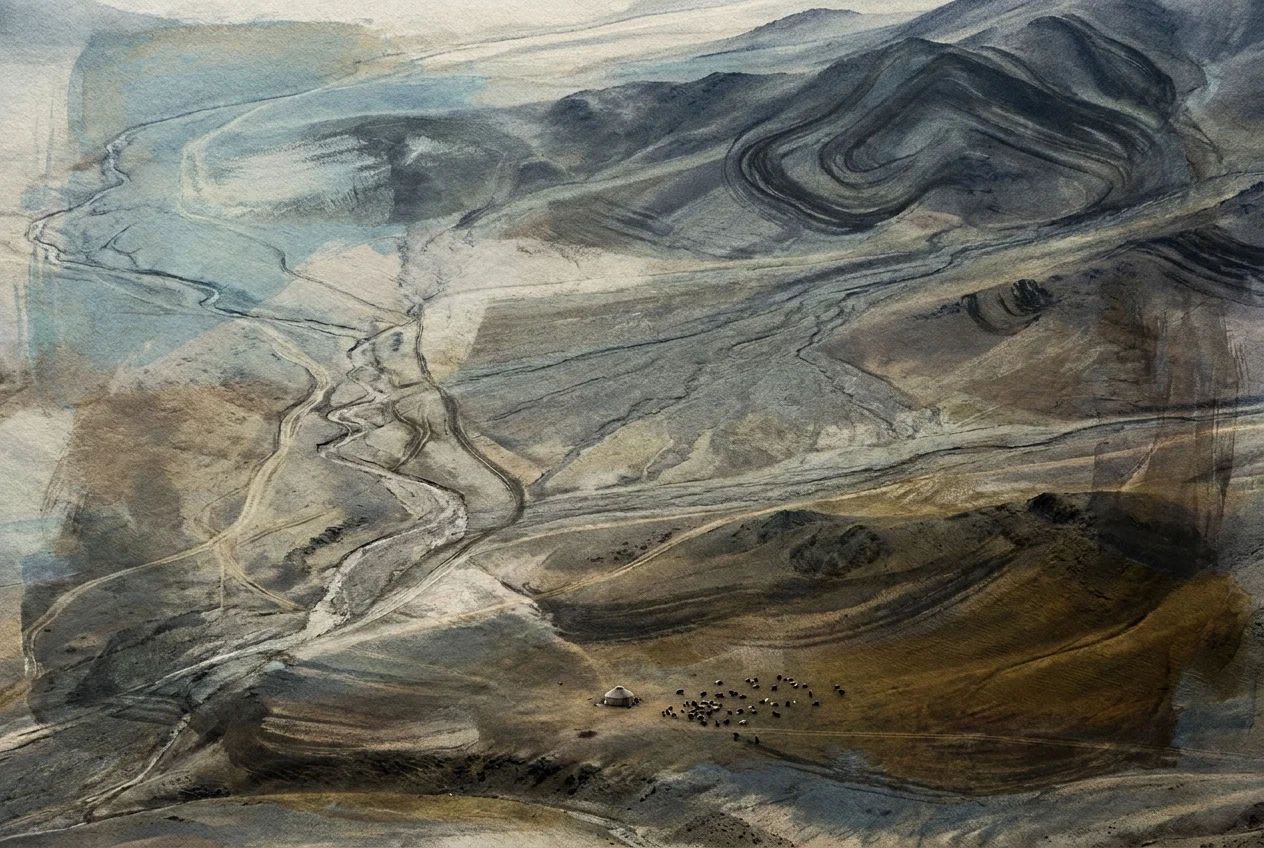
There is a Mongolian word often translated as homeland, native place or territory:nutag. Each translation is useful. None is sufficient.
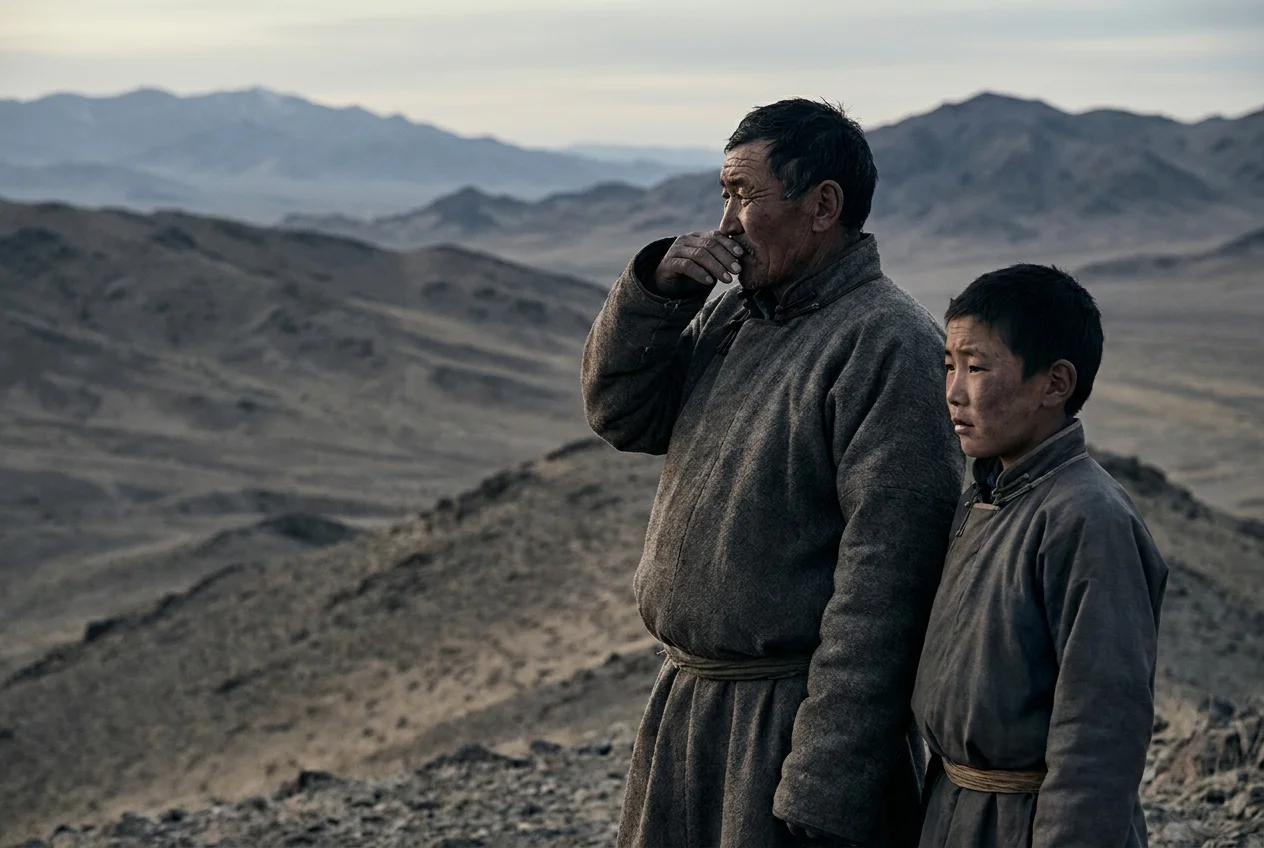
Nutag binds identity to a specific landscape: the routes a family knows, the pastures that can bear a herd, the places where ancestors are remembered and the seasonal signals that determine when to move. It is less a possession than a reciprocal relationship. A person belongs to the land by knowing how to respond to it.
Anthropological work on Mongolia describes this relation as more than human. Herding households, animals, water, mountains and pasture form an interdependent field rather than a hierarchy with people at its centre. That perspective may sound philosophical to an urban reader. In the Gobi, it is also risk management.
Pastoral knowledge holds information no satellite image can completely replace: which hollow keeps snow longest, which route becomes impassable after wind, which pasture needs another season before it can carry animals again. When a family leaves its nutag because of mining pressure, degraded land or herd loss, the economy loses more than labour. It loses situated intelligence accumulated across generations.
This is the first business lesson of the steppe: place-based knowledge is capital, even when no balance sheet records it.
IV. The Road of Wool
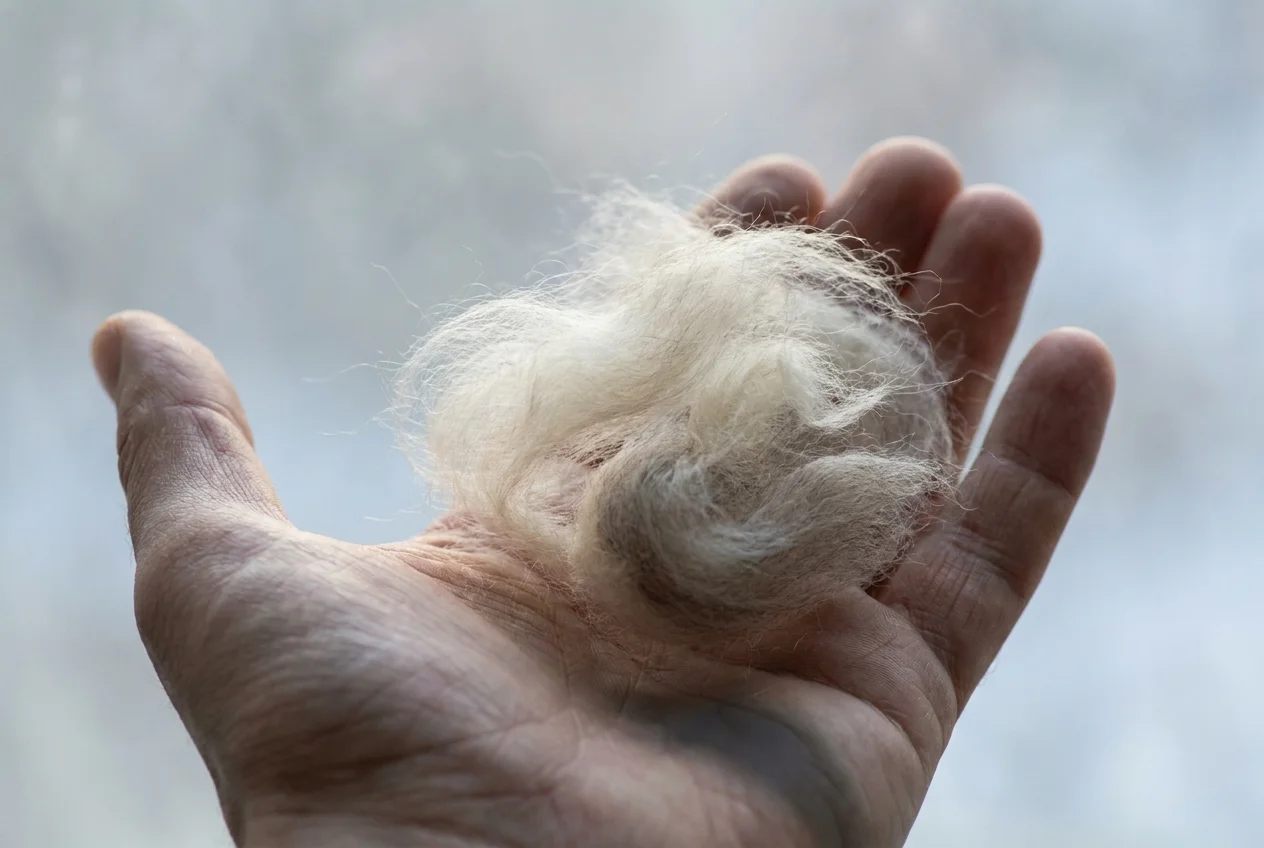
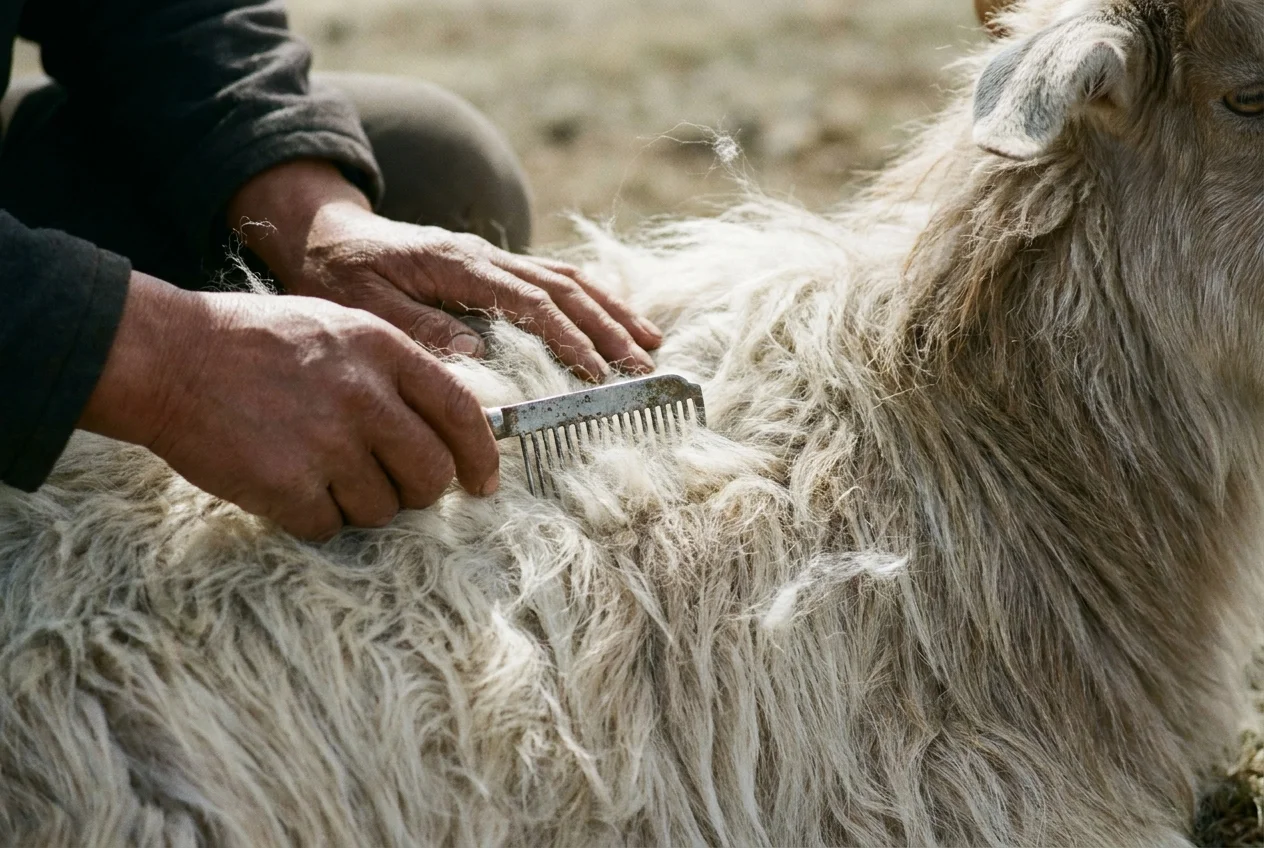
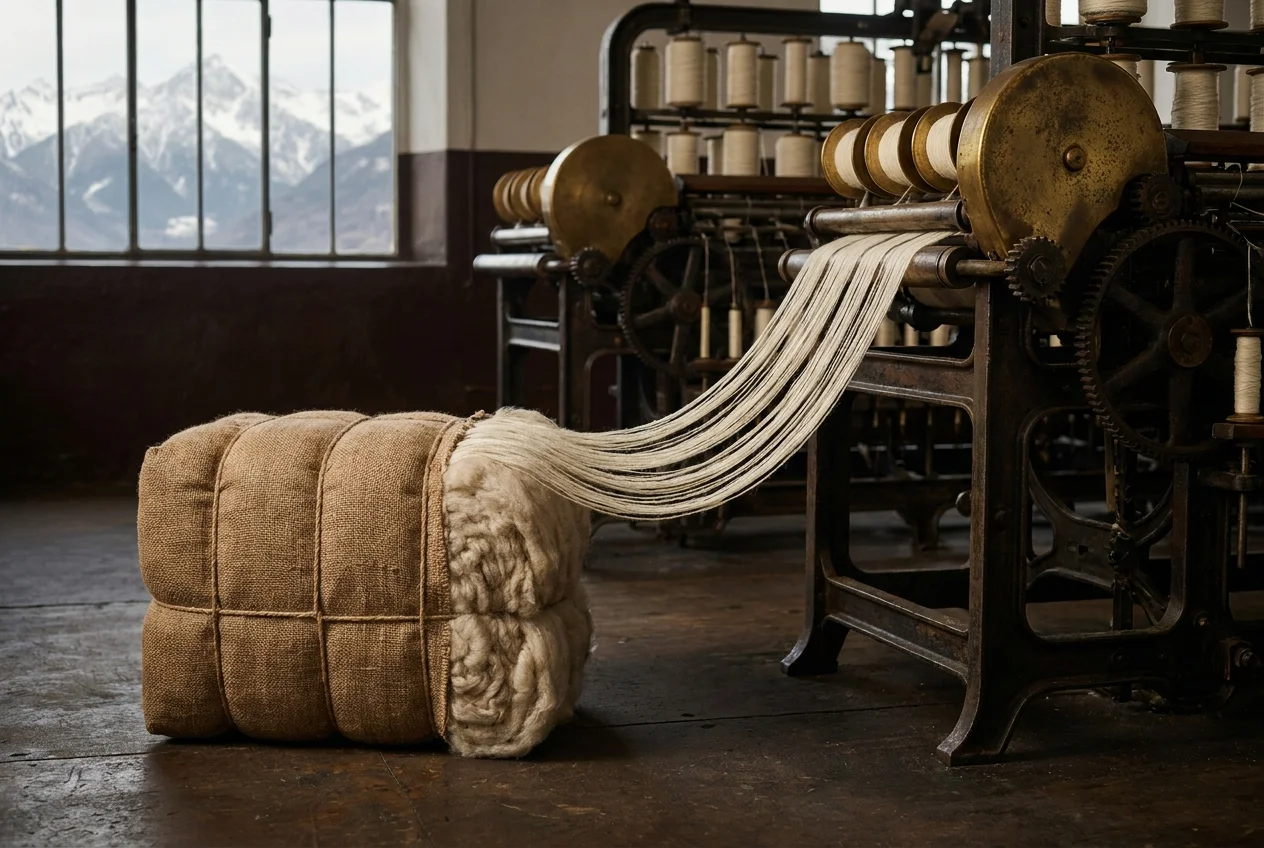
Each spring, as goats naturally shed their winter undercoat, Mongolian herders comb the fibre by hand. Cashmere begins as an adaptation to cold: a fine insulating layer developed close to the animal’s skin. Before it becomes a luxury product, it is evidence of climate.
The scale is considerable. An EU-supported value-chain analysis recorded 9,672 tonnes of raw cashmere produced in Mongolia in 2022 from 27.5 million goats. Mongolia remains the world’s second-largest producer after China. Yet production volume alone does not determine who captures value.
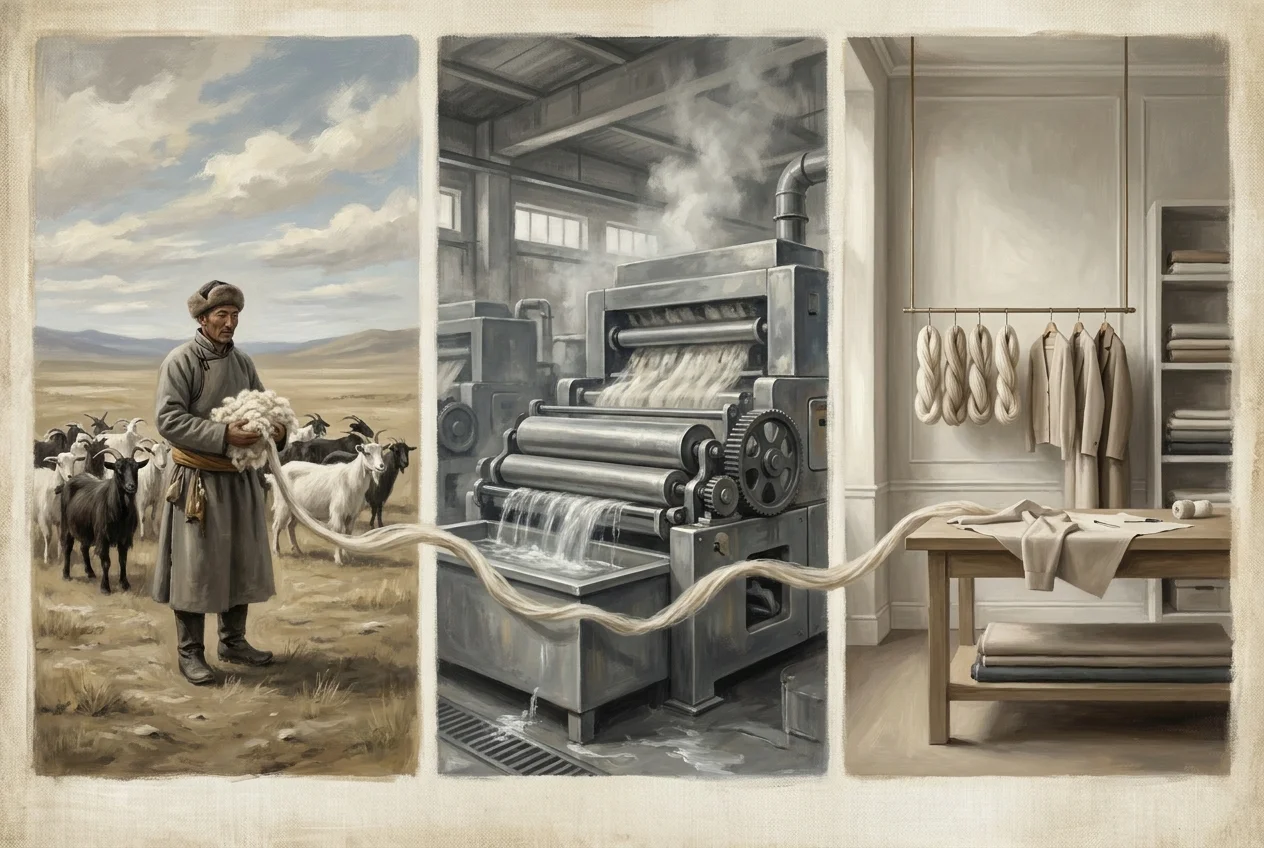
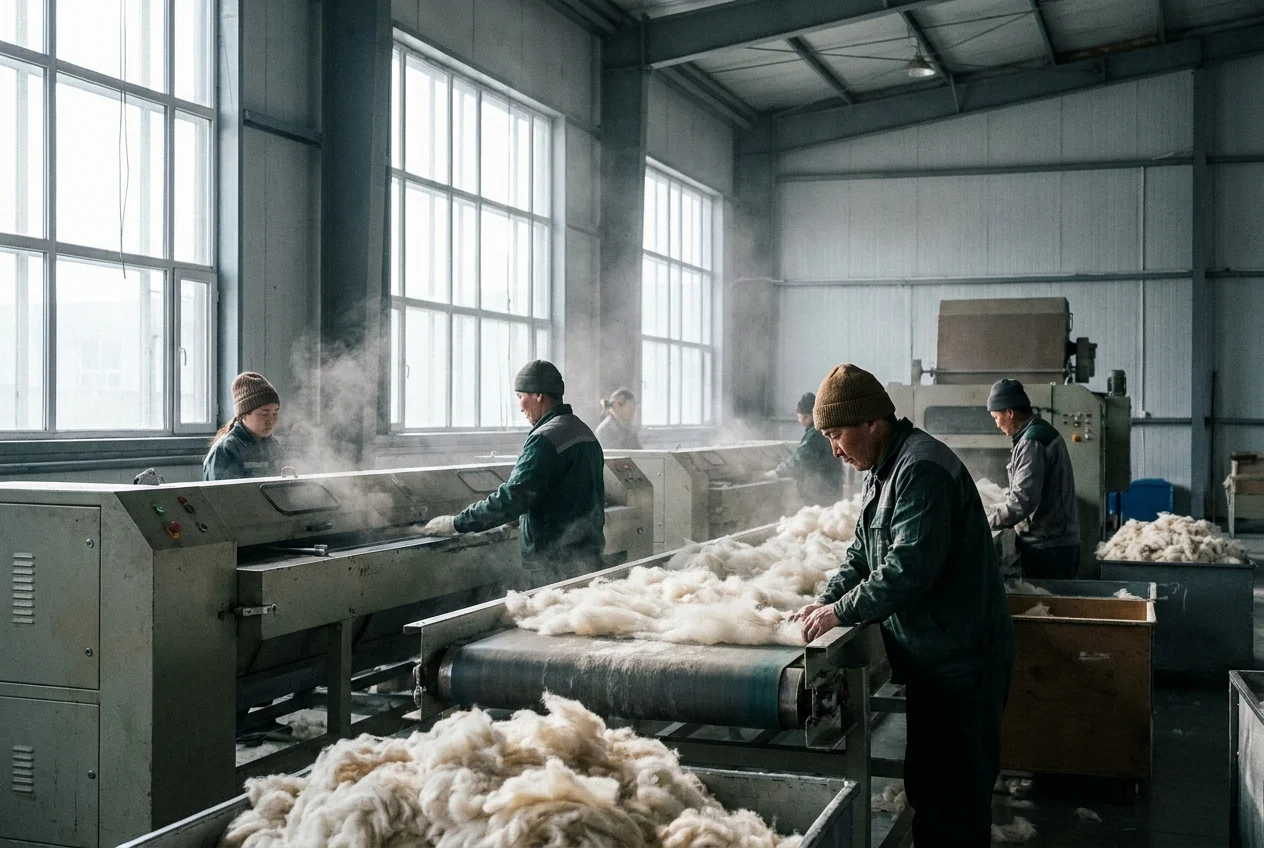
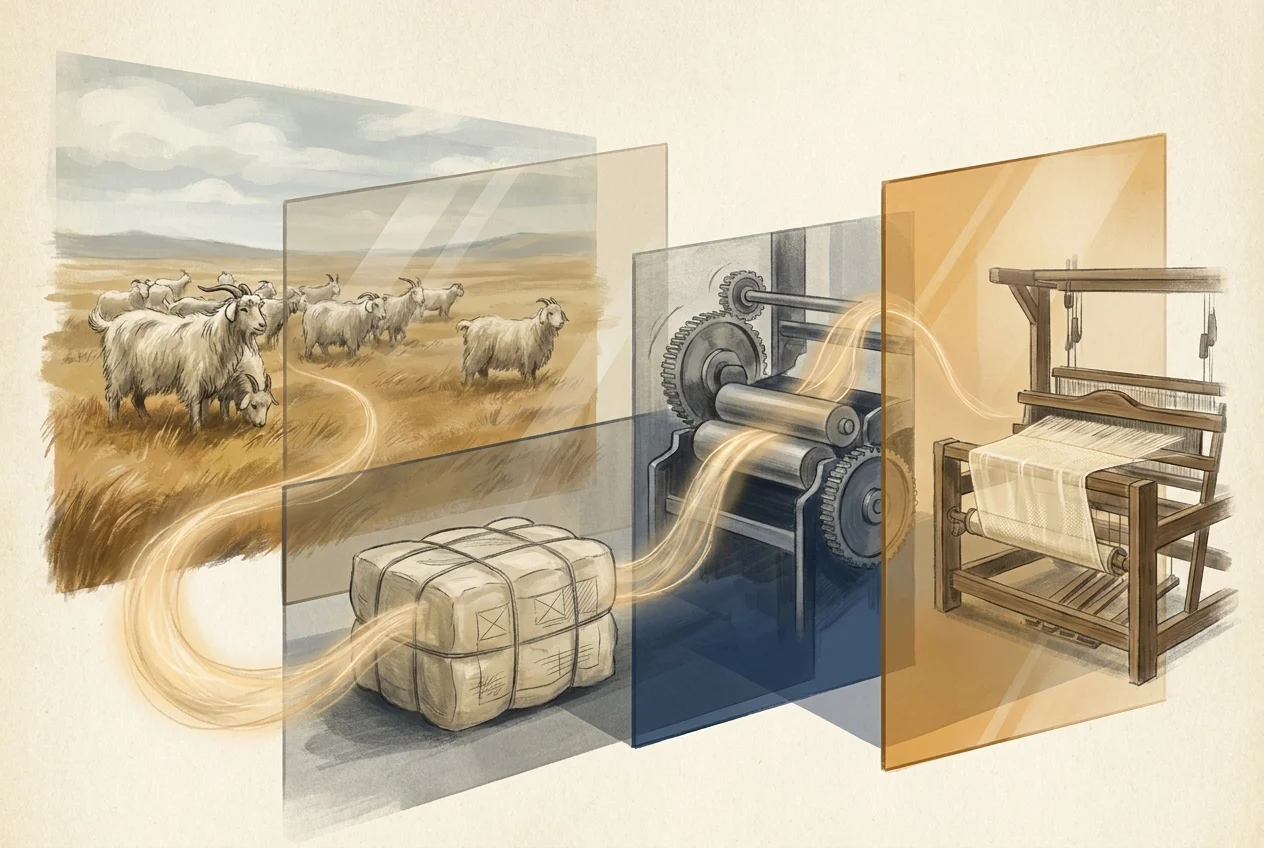
The same study identifies two main commercial routes. Approximately 75 per cent of annual production enters a raw-cashmere chain in which fibre is collected through intermediaries, washed and exported mainly to China. The remaining quarter enters a more vertically integrated system of sorting, washing, dehairing, dyeing, spinning and garment production. Around half of the dehaired fibre from that route is exported, principally to Italy, for further transformation.
The difference is not cosmetic. The study estimates that the integrated chain creates roughly €84,000 of value per tonne of raw cashmere, compared with about €49,000 in the less processed route. In 2022, the entire Mongolian cashmere value chain generated an estimated €581 million in value added.
This is where the story moves beyond fashion.
Mongolia does not lack a valuable material. It lacks sufficient control over the stages in which origin becomes margin: finance, sorting, dehairing, spinning, design, distribution and brand. Domestic processors must buy a year’s supply during a narrow spring window, often using expensive credit. Chinese buyers can compete with cheaper capital. The decisive advantage is therefore not simply fibre quality. It is the cost of money and the capacity to wait.
That is an important correction to the usual moral narrative. Intermediaries are not merely opportunists inserted between the herder and the atelier. In a fragmented geography, they aggregate volume, carry liquidity and absorb logistical risk. Removing them without replacing those functions would not create fairness; it would create absence.
The more useful question is how the chain can reward each function transparently while allowing more value to remain near the source.
Sector-level data and household experience reveal different truths. The EU analysis finds that herders collectively receive the largest share of direct value-chain profit. But that total is distributed across a vast number of households, each exposed to weather, animal mortality, transport costs, feed prices and volatile farm-gate prices. A processor or brand can diversify supply. A herding family cannot diversify the spring.
Reporting by New Lines Magazine makes that imbalance tangible. Herders described limited visibility into the eventual European value of their fibre and little influence over the price offered at the point of sale. Oyun, who leads a cooperative as well as tending livestock, argued that the people producing the raw material should participate more meaningfully in the value created when it becomes luxury.
The request is not sentimental. It is commercial.
A supply chain cannot call itself resilient while its least replaceable knowledge remains its least protected asset.
V. The Traceability Premium
Luxury has begun to answer with traceability.
Loro Piana now maps part of its cashmere journey through Smart Bales, following fibre from Mongolia through sorting, washing and dehairing in Ulaanbaatar to further transformation in Italy. The house is also participating in Resilient Threads, a five-year programme developed with the Sustainable Fibre Alliance, the United Nations Convention to Combat Desertification, local partners and herder cooperatives across five districts of Sukhbaatar province.
The Sustainable Fibre Alliance has built a broader standards and chain-of-custody infrastructure around animal welfare, pasture management, clean processing and documented separation of certified material. Its 2025 Mongolia summary reports that 53 cooperatives supplied more than 1,100 tonnes of certified raw cashmere to 17 domestic factories and enterprises. Those businesses exported 527 tonnes of dehaired fibre and 3.3 tonnes of yarn, generating $40 million in export revenue.
This is measurable progress: more organised sourcing, documented origin, processing standards and access to buyers.
But traceability and value sharing are not the same achievement.
New Lines reported that one Mongolian processor received only a modest premium—about three dollars per pound, and sometimes less—for certified fibre. The Sustainable Fibre Alliance itself notes that it does not set prices and that premiums vary by supplier and season. Certification may improve market access, bargaining capacity and access to finance; it does not guarantee that a meaningful share of the final retail value returns to the origin.
For luxury businesses, this distinction will become increasingly important. A traceability system can establish where a fibre travelled. It cannot, by itself, prove that the people and landscapes at the beginning of the journey became more secure.
The next standard of luxury sourcing will therefore need to move beyond provenance as information towards provenance as economic participation. That may include longer purchasing commitments, quality-linked pricing, lower-cost working capital for cooperatives and processors, investment in pasture restoration, transparent premium allocation and contracts designed around climate volatility rather than against it.
The business case is stronger than philanthropy. These measures protect fibre quality, supplier continuity, local knowledge and brand credibility at the same time.
Quiet luxury has always traded on restraint, material intelligence and permanence. Its supply chains must now demonstrate the same qualities.
VI. Dzud
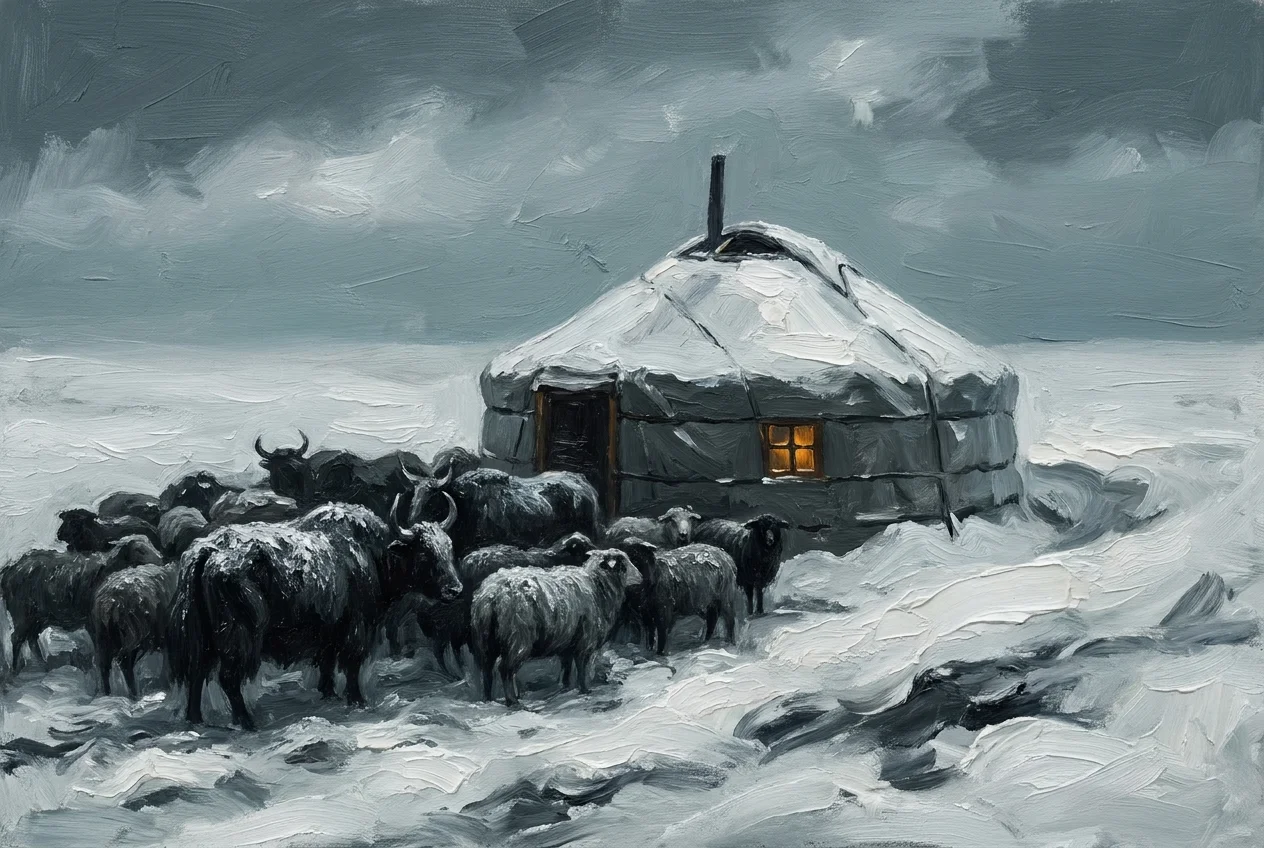
Mongolia has a word for the winter in which animals can no longer reach pasture:dzud.
The 2023–2024 season was among the most severe in recent history. Snow and ice restricted access to grass across much of the country. As official counts were revised upward, FAO’s later assessment placed livestock deaths at 9.12 million animals—almost 13 per cent of the national herd.
For a fashion company, this is a sourcing shock. For a herding household, it can be the destruction of income, food, transport, breeding stock and inherited work in a single season.
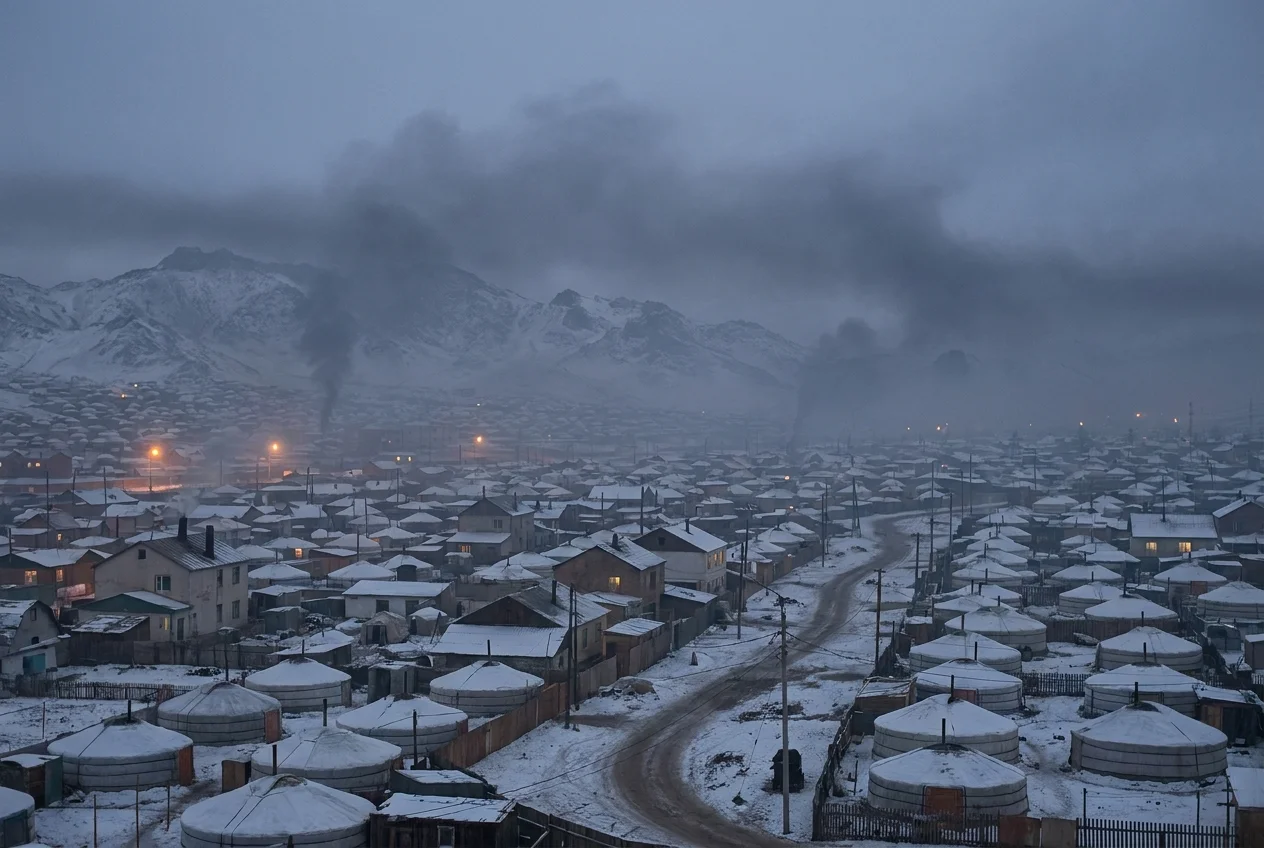
Climate exposure does not stop at the pasture. When herds collapse, migration towards Ulaanbaatar often follows. More than half of the capital’s residents live in ger areas, many without central heating and dependent on solid fuel through winter. The result is a second geography of vulnerability: a mobile dwelling adapted to open land becomes fixed on an urban perimeter, where density, inadequate infrastructure and trapped winter air turn shelter into a public-health problem.
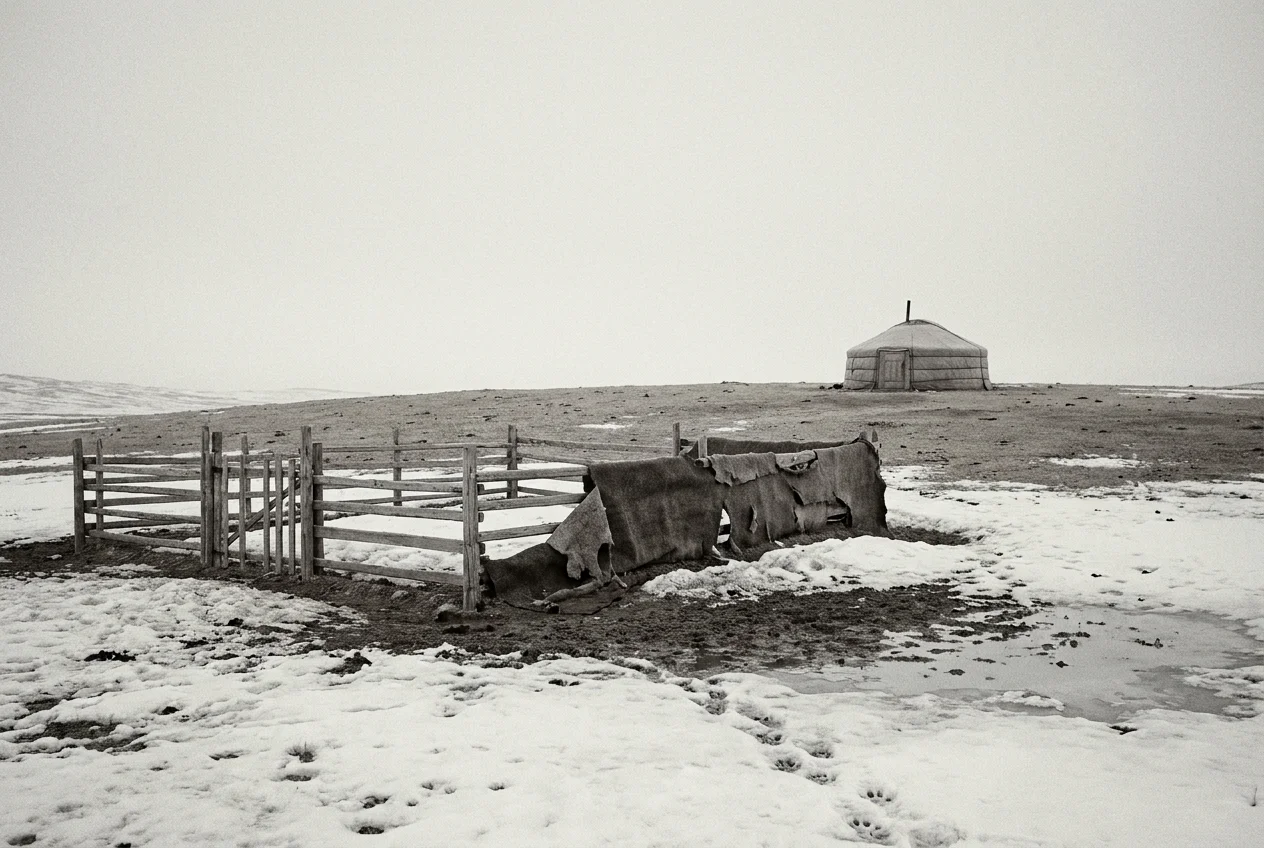
The ger has not failed. Its context has changed.
This matters because global luxury frequently treats climate as a disclosure category while suppliers experience it as a balance-sheet event. The Mongolian cashmere chain makes that distance visible. Weather affects animal survival, fibre volume and quality; it reshapes household debt and migration; it changes processor utilisation and export capacity; eventually, it reaches the atelier as price, scarcity and reputational risk.
Resilience cannot begin in Milan if the shock begins in Sukhbaatar.
VII. A Different Model of Hospitality
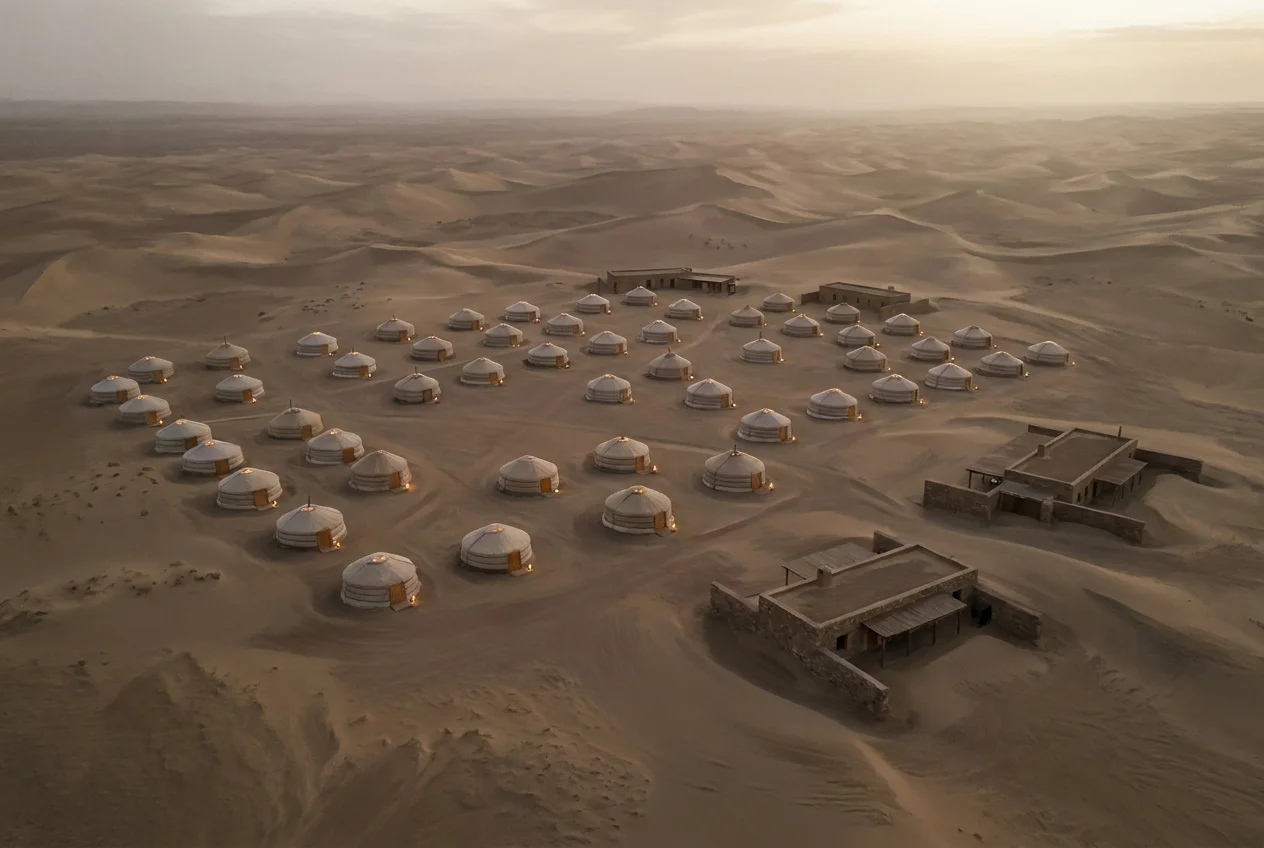
Near Gobi Gurvansaikhan National Park, Three Camel Lodge offers another view of how international demand can meet a local system without flattening it entirely.
The lodge comprises 40 handcrafted gers made by local artisans and arranged according to a plan inspired by Mongolian Buddhist temple architecture. Its buildings use local materials, and its public model emphasises Mongolian staffing, cultural preservation and conservation.
The significant detail is not that a ger can be made luxurious. That is the least interesting interpretation.
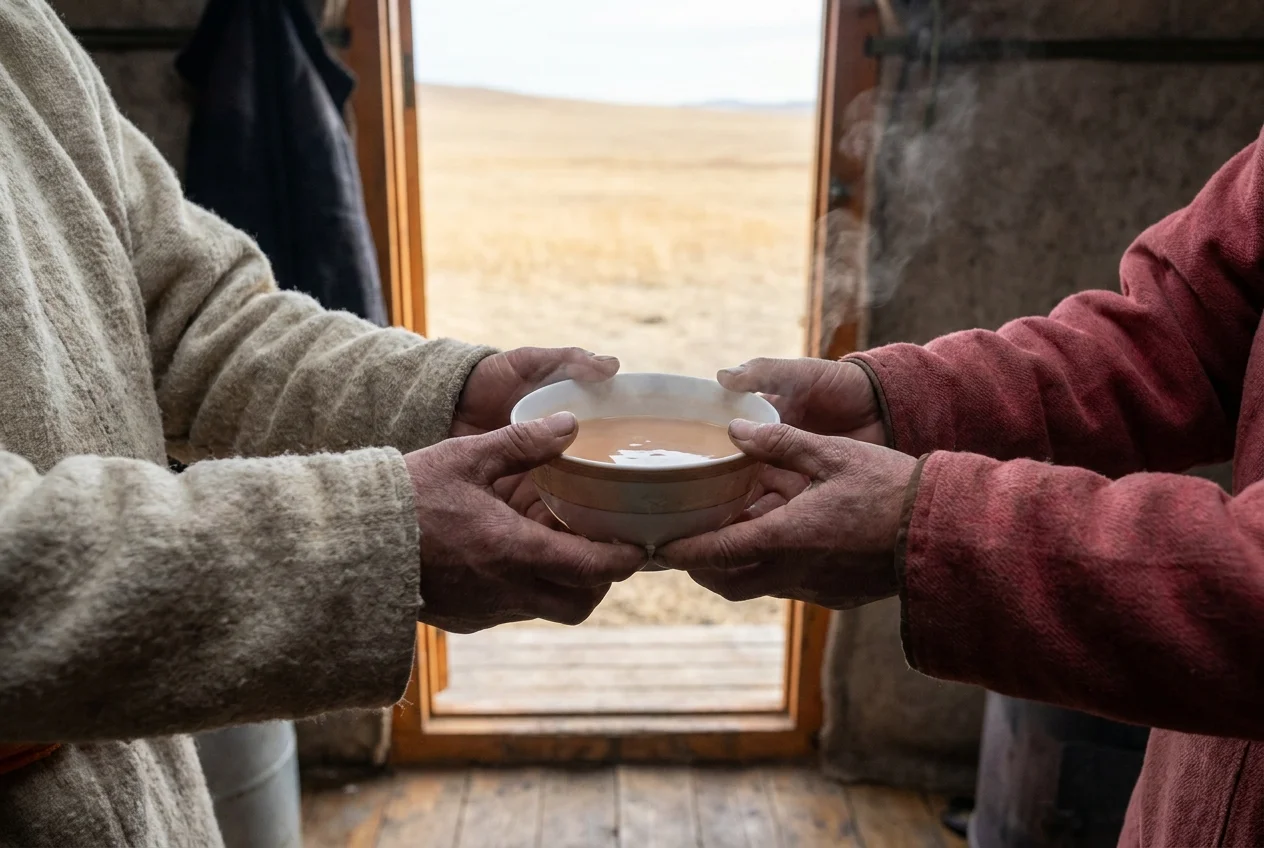
What matters is that hospitality here begins with an existing architecture of welcome. The commercial product did not invent silence, orientation, mobility or the ritual of receiving a stranger. It entered a culture in which those codes were already developed.
This changes the role of design. Instead of importing a universal idea of resort comfort and decorating it with local signs, the lodge can derive its value from the logic of the place: low visual impact, limited scale, local construction knowledge and an encounter structured by distance rather than distraction.
For hospitality businesses, that is a durable lesson. Authenticity is not a styling decision. It is the degree to which local knowledge retains authority over the guest experience.
When that authority is real, a property becomes difficult to copy. Its competitive advantage sits not in an amenity list but in relationships—with artisans, guides, landscapes, histories and seasonal limits. The result is not merely differentiation. It is permission to belong.
VIII. What Remains
The Gobi connects three economies that luxury usually presents separately: the economy of land, the economy of material and the economy of desire.
On the steppe, value begins with pasture, weather, animals and knowledge. In Ulaanbaatar, it becomes finance, processing capacity and export logistics. In Italy and other luxury markets, it becomes design, finish, distribution and narrative. Every stage is legitimate. The imbalance appears when the final narrative celebrates origin while the commercial architecture leaves that origin exposed.
Escale Privée does not reduce this to a verdict against luxury. Luxury can preserve rare skills, reward material excellence and finance standards that mass markets ignore. But its strongest houses understand a principle the Gobi makes impossible to avoid: scarcity without stewardship is merely depletion with better packaging.
The future value of Mongolian cashmere will not be secured by selling more fibre alone. It will depend on healthier pasture, fewer catastrophic household losses, stronger cooperatives, affordable capital for domestic processors, credible traceability and contracts that make resilience investable.
For brands, this is not a peripheral sustainability story. It is product strategy, supply security and cultural legitimacy.
For travellers, the lesson is quieter. The ger door still faces south. A guest entering it encounters a form of hospitality older than the market now built around its wool: a place offered, warmth held at the centre, attention given before identity is requested.
Escale Privée calls this a Geography of Belonging™—the point at which recognition replaces transaction and a place begins to alter the way one understands value.
The Gobi was there first.
The question is no longer whether the world will continue to arrive. It will.
The question is what it will leave capable of remaining.