.webp)
.webp)
The journey used to begin with a door.
A porter glanced up. A key waited in a tray. Somewhere behind the desk, a ledger held the small facts of arrival: name, room, rate, preference, promise. The ritual was physical because trust was physical. One handed over a passport, a card, sometimes a silence. The hotel received both person and proof.
Now much of that ritual happens earlier.
Before the car turns toward the entrance, before the receptionist has learned the guest’s name, before the room has cooled to the right temperature, another system has already begun to work. A wallet has authorized the payment. An app has applied the benefit. A tier has determined the rebate. A token has carried value across a border. A card has opened the lounge. A family office has approved the assistant’s spend. A quiet permission has moved through invisible architecture.
The new concierge may not stand behind a desk. It may live inside the wallet.
This is not merely a story about crypto. Nor is it only a story about fintech. It is a story about access — who designs it, who owns it, who profits from it, and how it begins to shape the journey before hospitality has had the chance to speak.
For years, travel treated payments as the final act. The room had been chosen, the flight selected, the itinerary arranged; only then did money appear. But that order is changing. Payments are becoming discovery, loyalty, identity, insurance, status, service, recognition. The financial layer no longer waits politely at checkout. It moves upstream. It begins to frame the trip.
This is the new territory. Not a travel trend in the decorative sense. A market. A power shift. A quiet redrawing of who owns the traveller.
The result is a new economy, still uneven, still noisy, but impossible to dismiss: travel fintech, crypto-native booking, wallet-led rewards, premium card ecosystems, payment gateways, stablecoin rails, private household infrastructure. A market measured not only in transaction fees, but in something more valuable: the relationship with the traveller.
Phocuswright expects online gross bookings to reach about $1.2 trillion by 2026, when nearly 65% of global travel gross bookings may be made online. Worldpay reports that digital wallets already account for 56% of global e-commerce spend. If travel continues to migrate through digital doors, the wallet becomes more than a way to pay. It becomes one of the doors. And doors, in travel, have always mattered.
.webp)
Before arrival
The most interesting travel companies now understand that the booking is not a moment. It is a corridor. At one end sits intention: the wish to go somewhere. At the other sits arrival: the bed, the view, the lobby light, the dinner reservation, the call from downstairs. Between them lies the machinery most travellers rarely see — payment authorization, currency conversion, loyalty recognition, fraud screening, refund policy, point accrual, insurance, identity, concierge, CRM. For a long time, this machinery belonged mainly to airlines, hotels, card networks and online travel agencies. A few names controlled the journey because they controlled either the room, the flight or the customer relationship.
Now new actors are entering through the financial side.
Revolut’s partnership with Booking.com is a clear example. Booking.com adopted Revolut Pay, giving millions of customers a one-click checkout option through a fintech they may already use daily. Revolut framed the move as an expansion of its travel footprint, citing more than 65 million global customers and almost 2 million monthly active Revolut Pay users at the time of announcement.
The significance is not that one can pay differently. The significance is that the payment method brings its own ecosystem: RevPoints, airline miles, Stays discounts, boosts, app behavior, stored identity, repeat use. The transaction becomes a loop. Book, pay, earn, redeem, return. A traveller may think they are choosing a room. The platform sees a lifetime. This is where the travel industry should pay attention. The company that owns the payment moment may begin to own the emotional memory around it. It knows when one books, where one goes, what one spends, which benefit proved persuasive, which currency removed doubt, which reward made return more likely. The hotel may still receive the guest. The wallet may have already understood them.
This is the old grammar of hospitality rewritten in financial syntax. Recognition no longer begins only with the general manager remembering a face. It can begin with an app remembering the spend.
.webp)
The crypto traveller is no longer theoretical
There was a time when booking travel with cryptocurrency sounded like a press release from the future. It no longer does.
Travala is the clearest case. Founded in 2017, the platform describes itself as a crypto-native travel booking service, offering access to more than 2.2 million properties across 230 countries, 600-plus airlines and hundreds of thousands of activities. It accepts more than 100 cryptocurrencies and traditional payment methods.
The numbers matter. Travala reported that gross revenue rose from $59.6 million in 2023 to $103.3 million in 2024. Crypto-paid bookings rose from $45 million to more than $80 million in the same period. Close to 80% of bookings, according to Travala’s own reporting, were paid with cryptocurrency.
That does not make crypto the future of all travel. It makes something more precise visible: there is a real segment of travellers for whom digital assets are not only held, traded or discussed. They are spent. They move through the world with another form of liquidity.
Binance Pay’s role on Travala sharpens the point. In 2024 it accounted for 8.5% of Travala’s transactions and had processed more than $18.5 million in crypto travel spend through the platform since 2021. This is not yet the dominant travel economy. But it is not imaginary.
Elsewhere, the signal grows. Alternative Airlines allows customers to book flights across hundreds of airlines using cryptocurrencies through payment partners. airBaltic accepted Bitcoin as early as 2014 and remains a useful reminder that this story did not begin yesterday. Emirates has now launched Crypto.com Pay for eligible UAE residents booking flights in dirhams through its website and app, implementing a partnership first announced in 2025. Bhutan, with Binance Pay and DK Bank, has gone further still: a national-level crypto tourism payment system, designed to let visitors move through flights, visas, merchants and local purchases with a wallet rather than a card.
These examples differ in scale and seriousness. Some are infrastructure. Some are experiments. Some are marketing. But together they point toward the same question: what happens when money itself becomes part of the itinerary?
The answer will not be simple. Crypto has carried too much theatre to be accepted uncritically by any serious travel house. But beneath the noise sits a practical proposition: borderless payment, speed, settlement, new customer segments, fewer inherited assumptions about banks, cards and national currencies.
For a generation that can move capital faster than it can move through airport security, the old rails may begin to feel provincial.
The mistake would be to confuse the surface with the structure. The surface is crypto branding. The structure is mobility.

Rewards become liquid
Crypto.com Travel makes the question sharper.
Launched as an in-app travel and entertainment booking experience powered by Bookit, it gives eligible users access to hotels, flights, cruises, car rentals and live experiences. But its real meaning lies in the way it is framed: not as an ordinary travel agency, but as an expansion of Crypto.com’s Level Up benefits program.
Travel becomes a use case for membership. Bookings can return rebates in CRO. Higher tiers receive richer benefits.
In older premium-card language, this is familiar. American Express, Chase, Capital One, Visa and Mastercard have long understood that travel benefits are among the most emotionally powerful instruments in financial services. Lounges, credits, upgrades, concierge services, hotel collections — these are not incidental perks. They are proof that a card can translate money into treatment.
Morgan Stanley Research has estimated that revenue from co-branded travel credit cards could grow from roughly $24 billion today to as much as $100 billion by 2035. The travel rewards credit card market is itself vast. Fintech and crypto are not inventing the financialization of travel. They are entering a prestige system that already exists.
What changes is the texture.
Points become more immediate. Wallets become more portable. Rebates become tokenized. Stablecoins promise cross-border settlement with fewer frictions.
Apps turn membership into something visible, counted, refreshed. A traveller no longer simply receives a benefit after loyalty has been accumulated.
The benefit can be embedded at the moment of payment.
This is why the next contest in travel may not be fought over inventory alone. It may be fought over interpretation. Who explains the value of a stay? Who turns a booking into a return? Who makes status feel natural rather than embarrassing? Who transforms a discount into a gesture?
The question is whether this makes travel more graceful — or merely more gamified.
Quiet luxury has never been impressed by noise. The finest form of access is the one that does not have to announce itself. A door opens. A name is known.
A problem is solved before it becomes a performance. If wallet-led travel is to mature, it will have to learn restraint.
.webp)
The bank as travel house
The bank has always travelled with the guest. It paid for the ticket, absorbed the exchange rate, covered the insurance, marked the statement. But it used to remain outside the story. The card appeared briefly, then disappeared. The hotel held the atmosphere. The airline held the route. The travel advisor held the taste. Now the bank, the fintech and the wallet want a more visible room in the house.
This is not accidental. Travel is one of the few consumer categories where spending still carries emotion, aspiration and identity. Groceries reveal habit. Travel reveals self-conception. A financial platform that understands how someone travels understands far more than disposable income. It sees rhythm, risk tolerance, destination preference, seasonality, family structure, loyalty behavior, appetite for ease, appetite for display.
That data has commercial value. It also has cultural value.
The old travel agent knew because they listened. The new financial platform knows because one transacts. Between those two forms of knowledge lies the moral question for the next decade of travel: can intelligent infrastructure preserve intimacy, or will it flatten every journey into a spend profile?
Escale Privée should not be nostalgic here. Nostalgia is too easy. The old world was not always more graceful; it was often merely slower. But the new world must be judged by the standard of the best hospitality: does it remove friction without removing humanity? A wallet that only accelerates consumption is not a concierge.
A wallet that protects time, privacy, intention and access may begin to resemble one.
The private household becomes a payment ecosystem
The most revealing case may not be a travel booking platform at all.
Bourgeois Bohème, known as BOBO, sits in a more discreet corridor: luxury fintech for high-net-worth families, private individuals, family offices and trusted teams. Its public LinkedIn profile describes a system of role-based wallet permissions, household access, staff delegation, instant transfers, custom payment devices and
a Control Hub through which principals and advisors can oversee transactions and bookings.
App-store materials describe BOBO Famex™ as financial infrastructure powered by Mastercard for modern families and private clients. The features are not only payments. They are household permissions, spending controls, concierge support, travel, purchases, bookings, premium lifestyle services. Other sources reference metal cards, 14K gold cards and wearable payment objects such as rings, leather bracelets and key fobs.
Here the wallet becomes something more intimate than checkout. It becomes house manager, access key, family-office tool, staff permission system, concierge interface. It belongs not only to travel, but to lifestyle — to the way a private world is coordinated, delegated and protected.
This matters because the future of refined travel will not be separated from the future of private life. A villa stay, a classic car event, a private aviation request, a household assistant booking a room, a child’s card with a limit, a principal approving a purchase from another country — these are not separate stories. They are fragments of the same new architecture.
The affluent traveller is not merely asking: where shall I stay? Increasingly, the question is: who has permission to move value through my world?
In that question, one hears the future of concierge.

The cost of friction
The market is not moving because technology is fashionable. It is moving because friction is expensive.
Travel payments are unusually complex. A flight may be purchased months before it is flown. A hotel may charge a deposit, then a balance, then incidentals.
A guest may cancel. A card may fail. A currency may move. A refund may be disputed. A merchant may need to reconcile thousands of payments across regions, channels and systems. The guest sees only delay. The operator sees margin disappearing in the pipes.
Outpayce from Amadeus reports that travel payment leaders are investing accordingly. The company’s research says 89% plan at least moderate investment, with 32% investing aggressively. Phocus Wire reported that travel companies planned to raise payment-capability investment by 12% on average, while 51% of travel payment leaders said keeping up with new payment methods was a challenge.
This is why the payment layer is becoming strategic. A smoother checkout can improve conversion. Local payment options can reduce abandonment. Better fraud tools can protect revenue. Better reconciliation can save time. A guest who can pay as they wish feels less resistance before they have even arrived.
The industry has begun to understand something hotels always knew in another register: arrival is emotional because it is operational. If the machinery fails, the mood changes.
.webp)
Trust will decide the market
The new wallet economy has an elegance problem.
Too much of crypto still sounds like speculation. Too much fintech still sounds like growth language. Too many rewards ecosystems confuse abundance with taste. Travel cannot afford to become a casino of points, rebates, tokens and tier anxiety. The industry already has enough noise. Regulation is one answer.
Europe’s MiCA framework brings crypto-assets into a more uniform regulatory perimeter, with rules around transparency, disclosure, authorization, supervision and market integrity. Stablecoins, too, may prove more relevant to travel than volatile assets because they speak the language travel understands: cross-border movement, settlement, predictability, currency. But regulation alone will not create trust. Refunds matter. Chargebacks matter. Consumer protection matters.
Crypto transactions are structurally different from card rails: blockchain payments are not reversed by the network in the way card disputes can be. Refunds become separate transactions. Disputes move into contracts, processors and policy. Merchants may appreciate the reduction in chargebacks; guests will still need confidence that mistakes can be undone.
The winners will not be the loudest platforms. They will be the ones that make the new infrastructure feel safe, legible and almost invisible. In travel, trust rarely announces itself. It is felt as a lack of anxiety.
This is the restraint the market must learn. A wallet may be fast. It must also be civilized.
.webp)
The new architecture of arrival
The old hotel key was a beautiful object because it concentrated meaning. It said: this room is yours, for now. It gave permission, but also suggested care.
Someone had prepared a threshold.
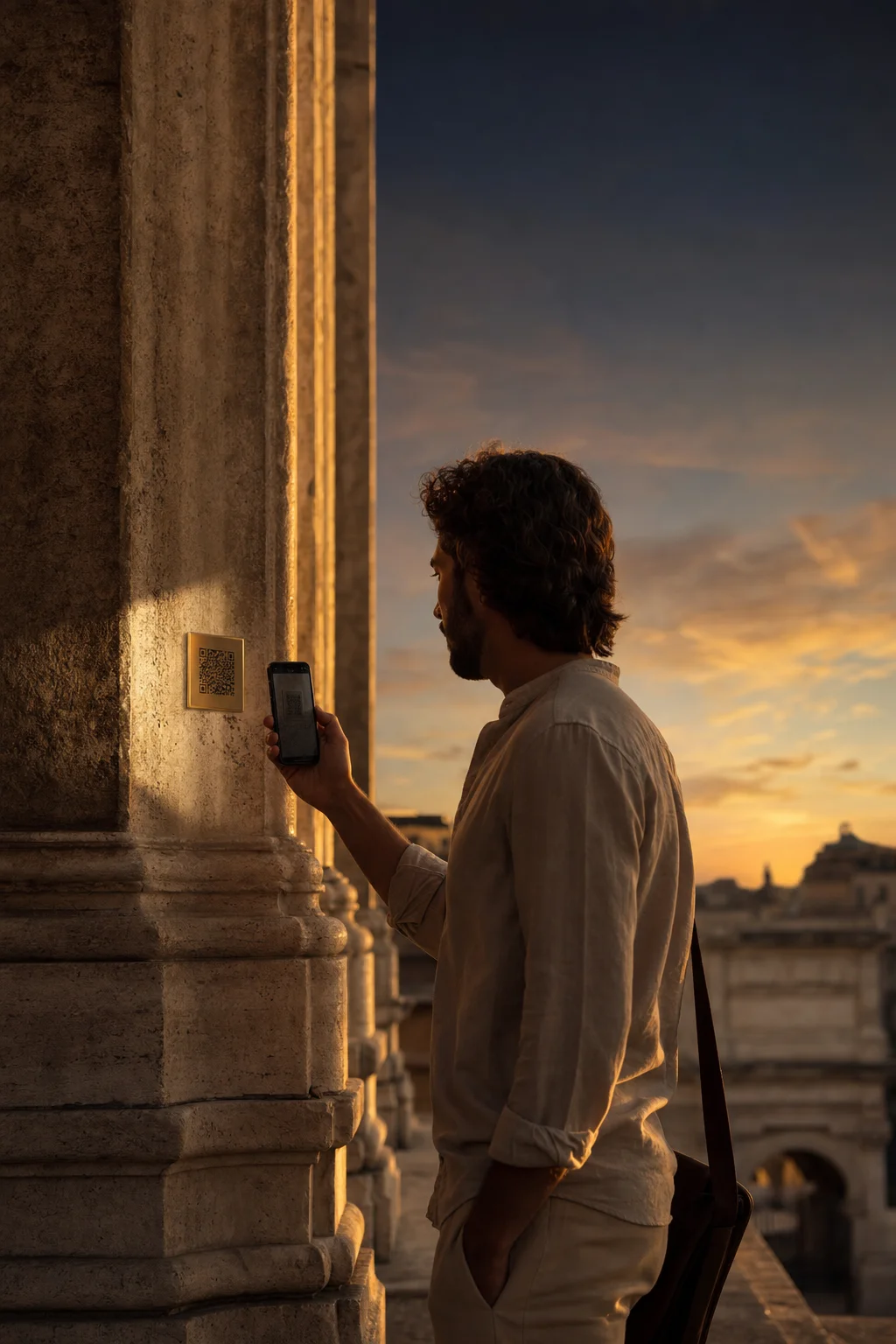
The new key may be less visible. It may be a stablecoin settlement, a card benefit, a wallet credential, a biometric approval, a role assigned to an assistant, a membership tier, a concierge chat, a tokenized rebate, a payment device worn as a bracelet, a QR code at a national monument, a lounge door opening because an app and a card agree on who one is.
Some of this will be vulgar. Some of it will disappear. Some of it will become infrastructure so normal no one will name it.
But the direction is clear enough. Travel is no longer shaped only by destinations, hotels and airlines. It is shaped by the systems that allow a person to move through them with less friction and more recognition. The wallet becomes the corridor. The app becomes the desk. The tier becomes the whisper. The payment becomes the beginning of belonging.
For Escale Privée, the question is not whether one pays with a card, a wallet or a token. That is a technicality. The real question is more interesting:Who is designing the new rituals of access?
Because the next frontier of travel may not be another island, another suite, another private terminal. It may be the invisible moment before the door opens.