Gian Paolo Barbieri owned three houses in the Seychelles. He kept none of them. When he returned to the islands years later, he stayed in one as a friend's guest. That private history reveals something about hospitality that preserved furniture and a former owner's name cannot.
I. A Return
After selling Mango House, Gian Paolo Barbieri continued to visit the Seychelles. He stayed at Tabù, a small house at Anse à la Mouche that he had bought, renovated and sold many years earlier. It now belonged to a friend.
His foundation records this: he returned to his former home as his friend's guest.
In the biography of a man who owned three properties in the Seychelles, this might seem like a footnote. Yet it changes how the whole story reads. Barbieri did not have to reclaim the house to live in it again. Nor did he need a hotel built around his own memory. A personal relationship gave him somewhere to return.
Another of his houses later became part of a hotel's story. Objects were preserved, his name remembered, elements of the old architecture re-created. Visitors could encounter the place through his biography.
He himself returned to a different address.
II. Fifteen Days
The first house began with a view.
Barbieri was in the Seychelles on assignment for Vogue Paris when he saw Anse Lisette from a hillside in southern Mahé. The magazine was preparing a feature on an archipelago undergoing change; Barbieri's brief was fashion. He had come to work. The land above the beach caught his attention.
According to his foundation, it belonged to Madame Trojan, a Seychellois noblewoman whose property included that stretch of coastline. He made an offer. He waited fifteen days for her to accept.
Here, the story of a man captivated by an island meets a less romantic fact: the beach had an owner. It was she who decided whether the photographer could stay.
He named the house Mompracem, borrowing the name from Emilio Salgari's Le tigri di Mompracem, published in 1900. He brought a fragment of Italian imagination to his new home: the pirate island familiar from literature.
The choice is more personal than a name taken from a bay or a local tree. It offers a glimpse of how an unfamiliar place begins to feel like one's own: a person recognises something in it that they had carried with them all along.
On 5 June 1977, less than a year after the Seychelles gained independence, a coup took place. Barbieri's foundation links the forced sale of his house and land to its aftermath, describing it in the context of the confiscation of property belonging to foreigners.
Mompracem remained, the foundation says, among his most cherished memories of the islands.
What survives in the record is the hillside, the beach, the fifteen days of waiting and the name. The interior life of the house — daily routines, the texture of time spent there — belongs to a past that left no written trace.
Barbieri kept returning. His connection to the Seychelles outlasted his ownership.
III. Clothes Without a Commission
From the 1980s, the islands increasingly became the setting for photographs he made outside commissioned work. His foundation describes him working outdoors, in natural light, without art directors or make-up artists.
The fashion photographer continued to look at clothes.
He recalled that, before boutiques arrived, many women on the islands made their own. He was interested in their everyday dresses and Sunday clothes, their particular aesthetic. It is a significant detail: he did not abandon his professional eye. He turned it towards people whose choices had not been made for a fashion shoot.
In a magazine commission, clothing has a defined purpose. Someone selects it, styles it, presents it. A garment worn off set belongs to a longer story: it was made, worn for a reason, and will be used after the photographer has gone.
That does not make it more innocent or more authentic. It changes the photographer's position. Barbieri was looking at a world that had not been arranged for his arrival.
In 1984, Silent Portraits, his first book of work made in the Seychelles, was published. He continued photographing on the islands over subsequent decades; that work also includes Equator, published by Taschen in 1999, and two books made with Pomellato.
These photographs let us see the story of the houses differently. If the Seychelles had been only a place to own, the story might have ended with Mompracem. Instead, the pictures continued, and so did the returns.
His work does not give us access to the islands' entire private world. It shows selected people, objects and moments. The photographer's proximity does not automatically become the viewer's. That limit matters: seeing someone is not the same as having a claim on their life.
IV. Mango Behind the Kitchen
The next house began with a refusal.
Madame Green had agreed to rent Barbieri a property above Anse aux Poules Bleues, his foundation recalls. When he arrived on a subsequent trip with his luggage, she changed her mind.
He bought a small house by the sea at Anse à la Mouche instead. He called it Tabù, renovated it and spent the summer of 1990 there.
Later that year, Madame Green offered to sell him her property. Barbieri sold Tabù to a Fiat executive and bought the house he had not been able to rent.
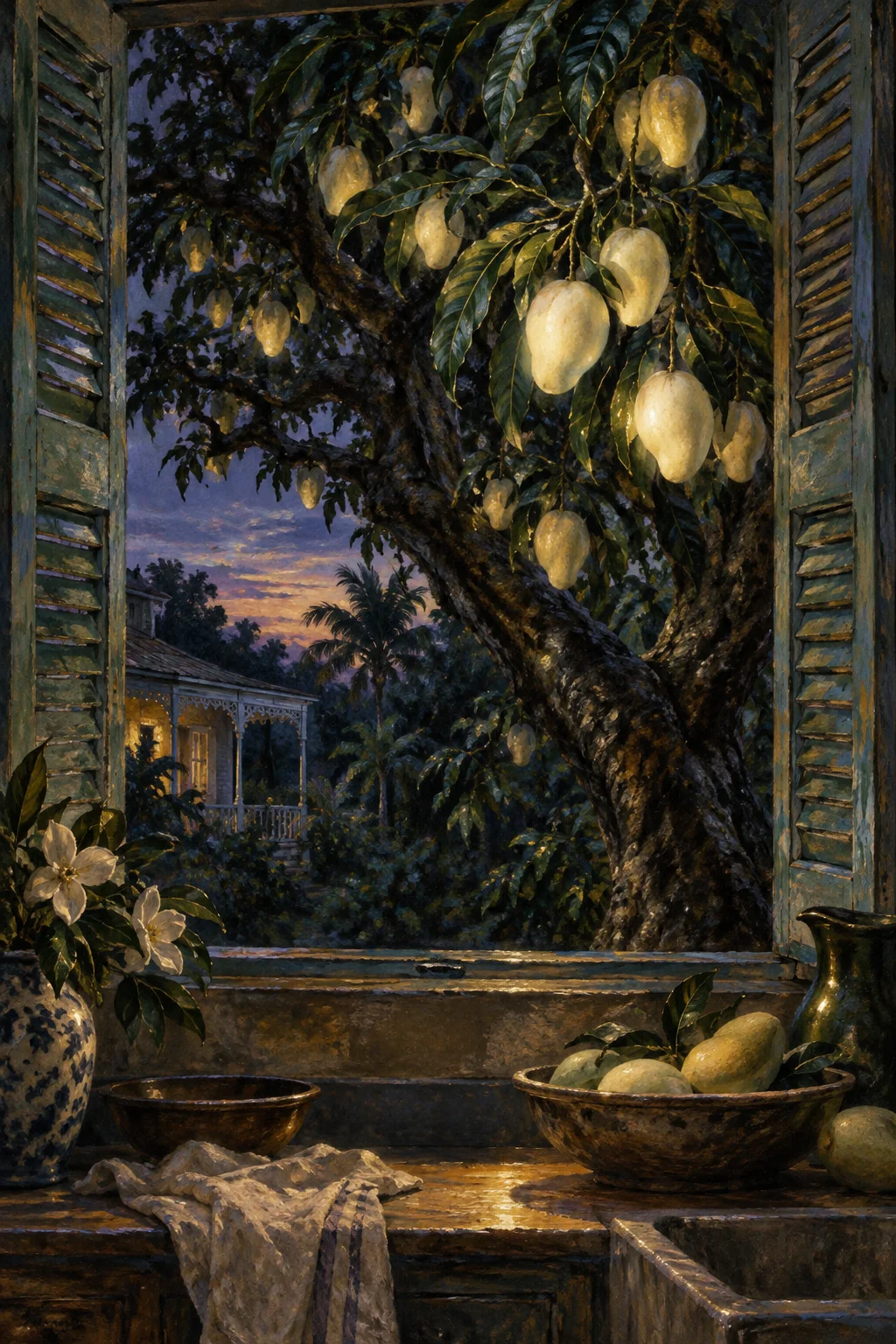
Behind its kitchen grew a tree bearing white mangoes. He considered them sweeter than any he had tasted. The tree gave Mango House its name.
Mompracem was named after a book. This house was named after something already growing there.
Barbieri planned it as a place for himself and his partner, Evar. In 1991, while work was still under way, Evar died.
The house now known for its association with a celebrated photographer had this less public history, too: it had been conceived for two. That changes the weight of the apparently simple fact that Barbieri kept it for more than twenty years.
The account tells us nothing about his daily rituals there or how his plans changed. We know that he kept the house long after the death of the person with whom he had hoped to share it.
V. An Address and Its Story
Barbieri sold Mango House in 2014. As he understood it, the buyer intended to create a private residence. The plans changed.
His foundation says the hotel project initially surprised him, but that he came to appreciate it. He saw the development as recognition of the property's value. It would be unfair to tell what followed as a story of harm done to the former owner.
Mango House opened under the LXR brand in the summer of 2021. It comprised forty-one rooms, suites and villas.
The original building was demolished.
In 2022, the design magazine identity described an orange house with few openings and a shower open to the sky. According to the magazine, the architects found it damaged by rising sea levels. The new main house was built on the same site, at the edge of the cliff.
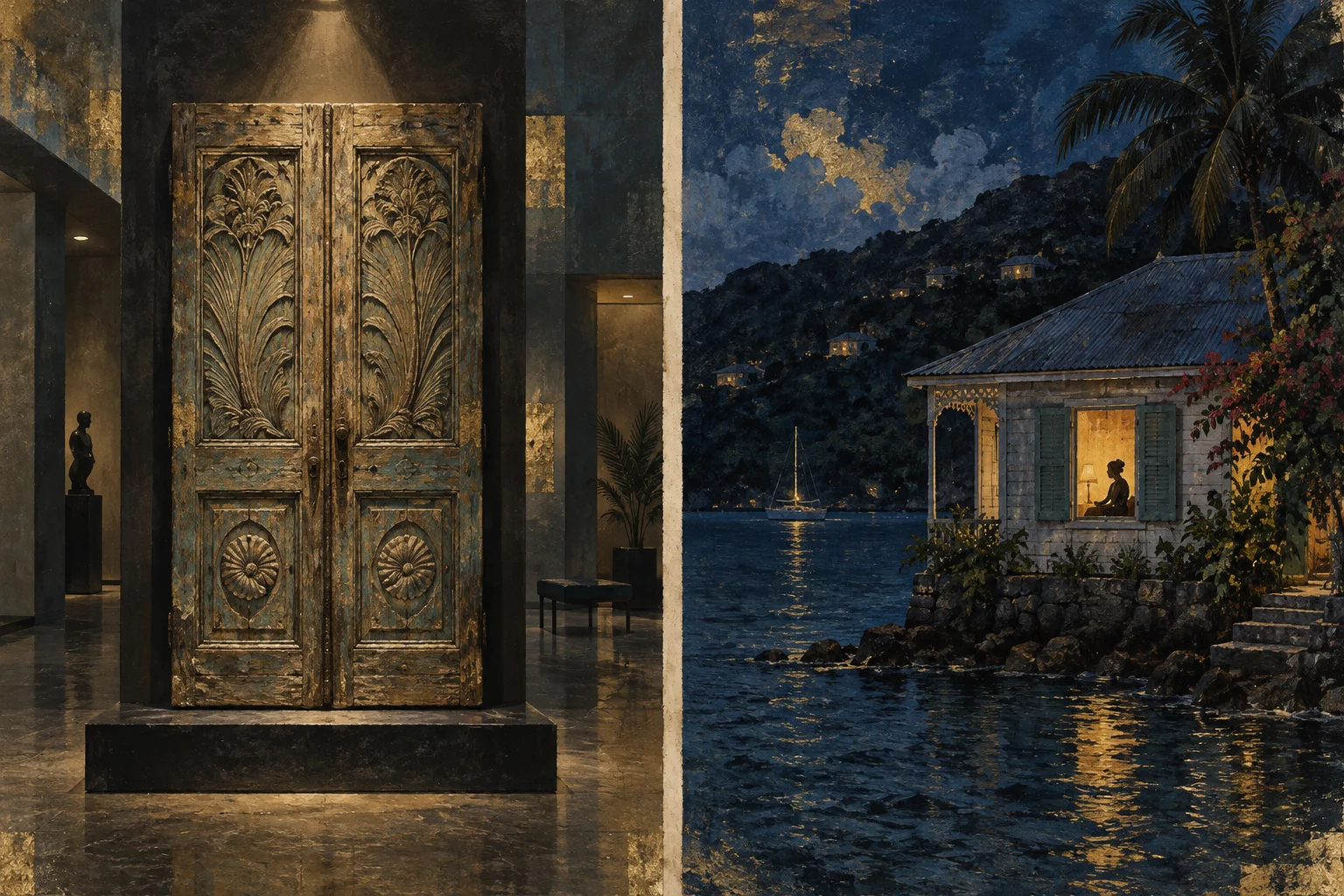
The report also listed what had been retained: the mango tree, some of the furniture and the front doors, turned into a sculpture. A ceiling of bwason sticks was recreated in the arrival pavilion. The architects also evoked the old house through the view: the lobby faced the water as Barbieri's window once had.
These details were documented in 2022. They do not establish where the objects are now or whether guests can see them.
There is real care in preserving these elements. The tree need not disappear with the building. Furniture can outlast its owner. An old architectural detail can inform a new design.
But this is where the history of a hotel begins to differ from the history of a home.
A guest can encounter the traces. They can learn who owned the doors, where the name came from and why the building faced the water. That is valuable knowledge. It does not transfer the private meaning of a place from one person to another.
Mango House mattered to Barbieri not simply because Gian Paolo Barbieri had lived there. It was bound up with the person with whom he had planned a life, with his own choices and with the years he returned. The name that opens the story for a hotel guest was not the reason he stayed.
That is why a hotel with a history should not be judged only by how many keepsakes it preserves. The more important question is what it does with the story it inherits: whether it lets its complexity remain visible, or smooths it into a familiar name and a handful of objects.
The front doors, made into a sculpture, mark that transformation with unusual clarity. They were saved, but they no longer lead into the house they once served.
VI. Hospitality After the Sale
Tabù survived in Barbieri's life in a different way.
Not through an architectural reference or a story prepared for visitors. The house belonged to a friend who welcomed its former owner. That is all the foundation tells us, and it is enough to see the difference.
We do not know whether Barbieri thought of those visits as recovering part of his old life. There is no need to put that thought in his mind. What matters is what happened: after selling the house, he could still stay there, now on different terms.
In that sense, the most private chapter of his returns is not about what he retained through ownership. It is about a relationship that made his stay possible.
The distinction matters to a traveller, too. You can book a room in a place connected to someone's life, see their objects and look towards the same stretch of water. You cannot, by doing so, inherit the reasons that made them feel at home.
A hotel can, however, create the conditions for a new connection. The previous owner's story does not relieve it of that task. It is the beginning of a place's story, not a ready-made experience for its next guest.
Gian Paolo Barbieri died in Milan, the city where he was born, on 17 December 2024. He was eighty-nine.
Mompracem remains in the foundation's account as a lost house and a name borrowed from a novel. Mango House acquired a public afterlife. Tabù returned to the photographer's life through friendship.
At one address, his doors were preserved. At another, he was able to stay again.
This essay draws on information provided by theFondazione Gian Paolo Barbieri ETS.